
Here’s one tip I learned about compounded annual growth rates or CAGR when getting the intrinsic value of a stock.
When we value stocks using discounted cash flow method or the Graham method, we always assume a growth rate and that variable has a very large effect to the outcome of the values we’re looking at. More often than not, we are confused as to what precise values we put into our equations. I read a tip from Jae Jun in his blog that there’s a much better way of getting the compounded annual growth rate based from past performances. This is what I’m going to share to you in this post.
To explain it in a clearer view, a business does not always tend to go up. The reality is that businesses tend to have good years and some bad years of earnings. The same can be applied to investments such as stocks too. Getting the CAGR in a certain period, let’s just say a 7-yr. period, disregards these bad years or in the case of stocks, disregards these short ups and downs so a better way of getting a realistic CAGR is to calculate it over multiple periods and get the median of all those values. This is to ‘smoothen out’ the data during periods when the business or a stock is doing good or bad.
Here’s an example of how it’s done. First, we get the 8-yr. EPS of a company we want to value.
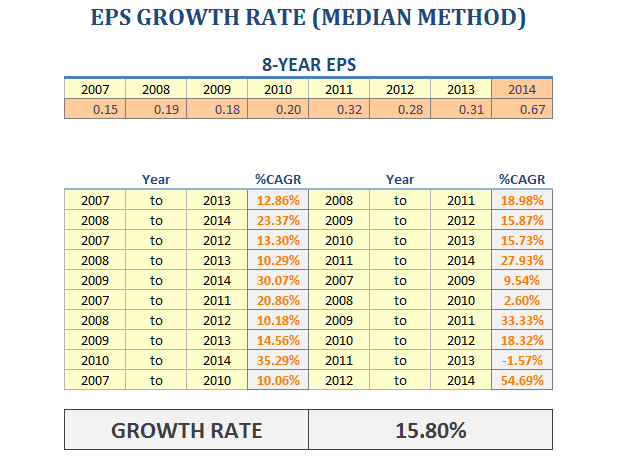
Assuming the values on the above illustration, what we do next is to get the CAGR for the 6, 5, 4, 3 and 2-yr. periods within the 8-yr. period. The formula for computing CAGR is this;
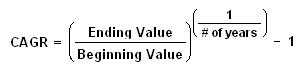
(image taken at Investopedia)
The final growth rate is now computed by taking the median of all the values taken from the individual periods. When using Excel spreadsheet, the median is computed by using this syntax;
MEDIAN(number1, [number2], …)
In the above example, we arrived at a value of 15.80% growth rate.
To make it easy for you, you can download the spreadsheet about it below. Now try to compute for the growth rates of the stocks you own and find its intrinsic value using the CAGR you computed here.
[sociallocker]Growth Rate Calculator – www.investingengineer.com[/sociallocker]
To summarize, to calculate the growth rates based on past performance, we compute for the CAGR over different periods inside a 7-yr period. We then take the median of these values and the final value that we would get is to be used to calculate the projected free cash flow.
Happy investing!