
If you’ve checked the news lately and seen headlines about a new Federal Reserve Chair, you’re not imagining things. Kevin Warsh took over from Jerome Powell in 2026, and the way he’s running the Fed so far has surprised a lot of people, including some of the professional investors who thought they had him figured out. Kevin Warsh, the new Fed Chair, has moved further and faster on inflation than most expected, while also changing how the central bank communicates with the public. If you’re a beginner investor trying to understand what any of this means for your money, this guide walks through who Warsh is, what’s actually happened since he took the job, and what to watch going forward.
TL;DR / Key Takeaways
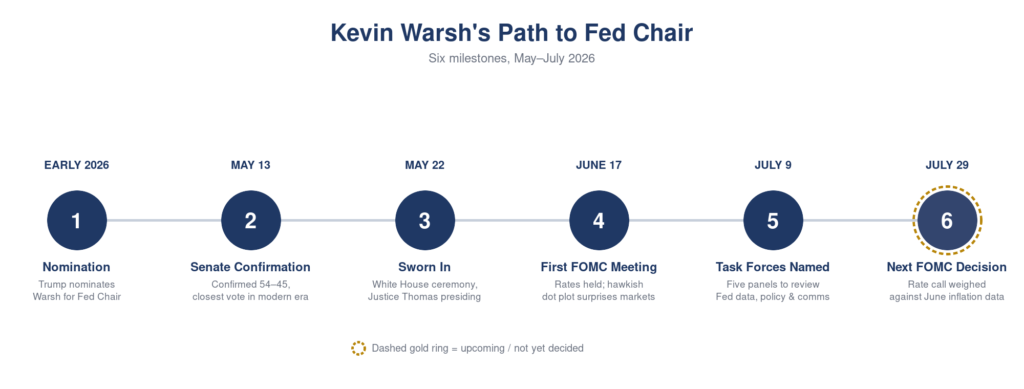
- Kevin Warsh was confirmed by the Senate on May 13, 2026, and sworn in on May 22, 2026, becoming the new Federal Reserve Chair.
- Before taking office, Warsh was widely seen as likely to cut interest rates. Since becoming chair, he has taken a noticeably hawkish, inflation-focused stance instead.
- At his first Fed meeting on June 17, 2026, the Fed held rates steady but signaled it’s now more likely to raise rates later in 2026 than to cut them.
- Warsh has cut back on the Fed’s usual forward guidance and launched five task forces to review how the Fed measures data, communicates, and manages its balance sheet.
- For investors, the practical takeaway is to expect more volatility around Fed meetings and to think in terms of diversification across sectors and asset classes, rather than betting on a single direction for rates.
Who Is Kevin Warsh?
Kevin Warsh isn’t a newcomer to the Federal Reserve. He served as a Fed Governor from 2006 to 2011, which means he was inside the building during the 2008 financial crisis, one of the most difficult stretches in the Fed’s history. Before that, he worked as an investment banker at Morgan Stanley, and after leaving the Fed, he spent time as a Visiting Fellow at Stanford’s Hoover Institution and as a partner at Duquesne Family Office, the investment firm run by well-known investor Stanley Druckenmiller.
That combination of Wall Street, government, and academic experience makes Warsh a bit different from recent Fed chairs, who mostly came from academic economics backgrounds. He’s been a public voice for years, arguing that the Fed talks too much, leans too heavily on tools like quantitative easing, and should let markets react to real data instead of pre-announced plans.
Career Highlights and Path to the Fed
- Federal Reserve Governor, 2006–2011.
- Former mergers-and-acquisitions banker at Morgan Stanley.
- Advisor during the 2008 Global Financial Crisis.
- Visiting Fellow, Stanford University’s Hoover Institution.
- Partner at Duquesne Family Office.
- Nominated by President Trump and confirmed as Fed Chair in 2026, succeeding Jerome Powell.
How He Was Confirmed (and Why the Vote Was So Close)
Warsh’s confirmation wasn’t a formality. The Senate confirmed him on May 13, 2026, by a vote of 54–45 — a nearly party-line result and the closest confirmation vote for a Fed chair in the modern era. For comparison, Jerome Powell was confirmed 85–12 back in 2018. Only one Democrat, Pennsylvania Senator John Fetterman, crossed party lines to support Warsh. He was sworn in on May 22, 2026, in a White House ceremony administered by Supreme Court Justice Clarence Thomas — the first time a Fed chair has been sworn in at the White House since Alan Greenspan in 1987. His term as chair runs through May 2030.
The closeness of the vote reflects a broader concern that came up repeatedly during his confirmation hearings: whether Warsh can keep the Fed independent from political pressure, especially given that President Trump publicly and repeatedly pushed for lower rates and criticized Powell during his final years in office.
Dovish Nominee, Hawkish Chair — What Actually Changed
Here’s the part of the story that trips a lot of people up, so it’s worth spelling out clearly.
What Warsh Said Before Taking Office
While campaigning for the role, Warsh had called for lower interest rates and was widely viewed as aligned with President Trump’s preference for cheaper borrowing costs. Markets and analysts largely expected a “dovish” Fed under his leadership — meaning one more inclined to cut rates and support economic growth, even if that meant tolerating somewhat higher inflation in the short term.
What the Fed Has Done Since May 2026
Once in the chair, Warsh’s tone shifted. He has said plainly that if businesses or households expect the Fed to accept inflation running above its 2% target, “they’d be disappointed,” and that the Fed is “going to deliver price stability.” He’s also described inflation as a “choice,” suggesting the Fed’s own credibility and follow-through matter as much as outside economic shocks.
This is not a small pivot. It means the “easy money” narrative that many investors priced in around his nomination hasn’t played out — at least not yet. Whether that changes as political pressure continues is one of the more important open questions for the rest of 2026.
Inside Warsh’s First FOMC Meeting
The Rate Decision and Dot Plot
Warsh’s first meeting running the Federal Open Market Committee (FOMC) took place on June 17, 2026. The Fed voted unanimously to hold its benchmark federal funds rate steady at a range of 3.50% to 3.75%. On the surface, that sounds uneventful. But the accompanying “dot plot” — the chart showing each Fed official’s anonymous projection for future rates — told a much more hawkish story: nine of eighteen officials penciled in at least one rate hike before the end of 2026, a sharp reversal from March, when the committee’s median projection called for a rate cut. The median year-end 2026 rate projection jumped to 3.8%, up from 3.4% just three months earlier, and the median inflation projection was revised up as well.
Notably, Warsh chose not to submit his own dot in the projections, saying he didn’t think it would be “helpful in the conduct of policy.” That’s a break from how recent Fed chairs have operated, and it’s a preview of the broader communication changes discussed below.
How Markets Reacted
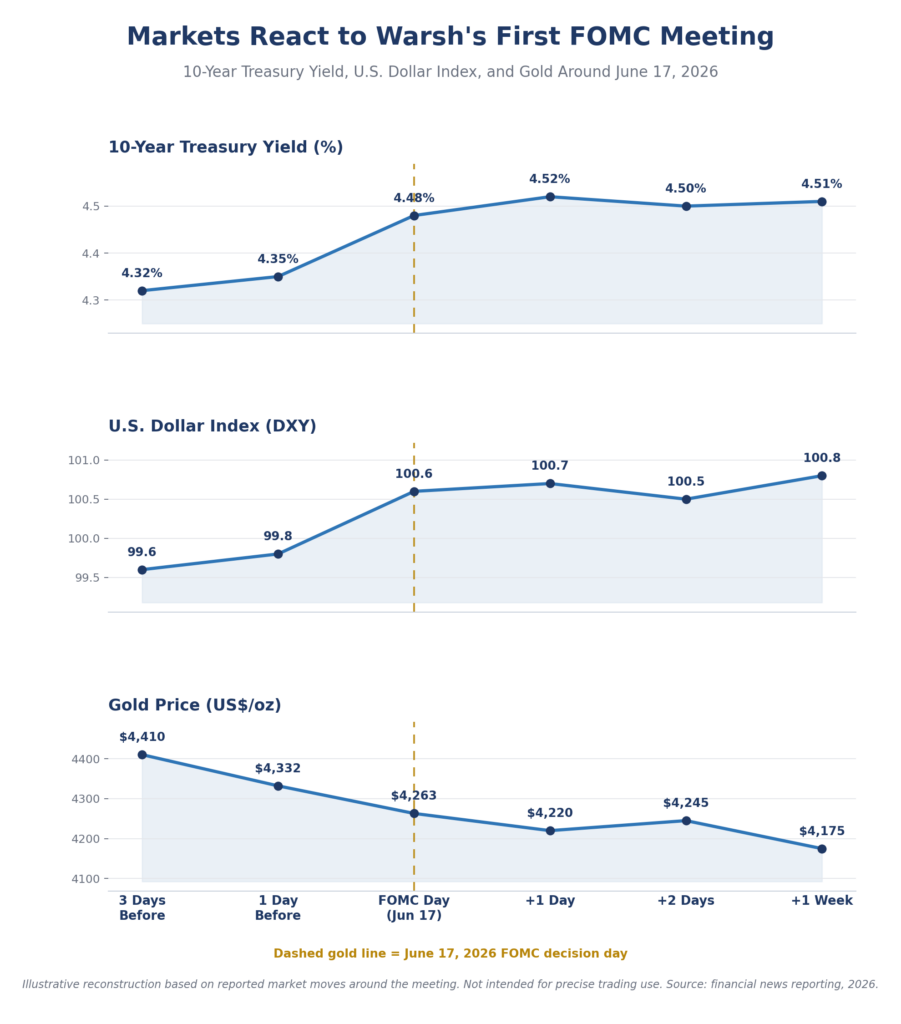
Markets did not take the hawkish surprise well. On the day of the meeting, the S&P 500 fell 1.21% and the Nasdaq dropped 1.34% — what Charles Schwab described as the worst “Fed day” for a debuting chair since 1994. Bond markets moved sharply too: the 2-year Treasury yield saw one of its largest single-day moves in over a year, and the 10-year Treasury yield climbed back toward 4.5%. The U.S. Dollar Index (DXY) jumped roughly 0.9% to around 100.5–100.7, a high for the year at the time, while gold sold off about 3.5% for the week as a firmer dollar and higher real yields made the metal less attractive.
FOMC Days Move Fast — Here’s How to Follow Along
Warsh’s first meeting produced the worst “Fed day” for a debuting chair since 1994, with stocks, bonds, the dollar, and gold all moving within minutes of the statement. If you’re interested in how that kind of volatility plays out in the FX and gold markets, Pepperstone lets you follow and trade the action as it unfolds. As with any trading decision, understand the risks before committing capital.
Explore Pepperstone →The Fed’s New Playbook: Less Guidance, More Data
Forward Guidance and the Dot Plot
One of Warsh’s long-standing arguments is that the Fed talks too much about its future plans, and that doing so can box the central bank into decisions that no longer make sense once new data arrives. Consistent with that view, his first FOMC statement as chair was notably shorter than usual and largely stripped of forward-looking language about where rates are headed next. Combined with his decision not to submit a personal dot-plot projection, this points to a Fed that wants markets leaning on incoming economic data — inflation reports, jobs numbers, spending figures — rather than on Fed hints, meeting to meeting.
| Fed Communication Style | Powell Era | Warsh Era (So Far) |
|---|---|---|
| Forward guidance | Detailed, frequent | Minimal, meeting-by-meeting |
| Personal dot-plot projection | Provided | Withheld by the chair |
| FOMC statement length | Longer, more detailed | Notably shorter |
| Framing of inflation | Data-and-shock-driven | Explicitly framed as partly a “choice” tied to Fed credibility |
The Five Fed Task Forces
On July 9, 2026, Warsh announced the leadership of five task forces charged with reviewing how the Fed operates:
- Data — improving the quality and timeliness of the economic data the Fed relies on.
- Productivity and Jobs — assessing how new technologies, including AI, are affecting the labor market and productivity.
- Inflation Frameworks — revisiting how the Fed understands and responds to what drives inflation.
- Communications — reviewing how the Fed explains its decisions to the public and markets.
- Balance Sheet Policy — examining the costs and benefits of the Fed’s current approach to its bond holdings.
The panels include high-profile names such as former Walmart CEO Doug McMillon, venture capitalist Marc Andreessen, former Bank of England Governor Mervyn King, and economist Greg Mankiw. They’re expected to report their findings by the end of 2026, and the outcomes could reshape how the Fed operates well beyond Warsh’s specific rate decisions. It’s worth noting, though, that structural reform inside a large institution like the Fed tends to move slowly — as of mid-July 2026, reporting suggested Warsh had made limited concrete progress on at least one of his priority reforms, a reminder that big changes in Fed process can take longer to materialize than headlines suggest.
What Investors Should Watch
Interest Rates and Treasury Yields
The federal funds rate remains the single biggest lever affecting borrowing costs across the economy — mortgages, auto loans, credit cards, and business lending. If June and July inflation data (including the June Consumer Price Index and Personal Consumption Expenditures reports) come in hot, Warsh’s Fed looks more likely to raise rates at or after its July 29, 2026 meeting. If inflation cools meaningfully, the Fed could hold steady for longer or eventually pivot toward cuts. As of mid-July 2026, the 10-year Treasury yield sits around 4.5%, reflecting the market’s expectation that rates stay elevated for a while.
Watch the Rate Path in Real Time
The gap between “hold” and “hike” will likely keep moving as new CPI and PCE data lands ahead of the July 29 FOMC meeting. Pull up the 10-year Treasury yield on a live chart and set an alert so you see the move as it happens, not the next morning.
Track the 10-Year Treasury Yield on TradingView →Stocks by Sector
Different sectors respond differently to a “higher-for-longer” rate environment.
| Sector | Likely Impact Under a Hawkish Warsh Fed |
|---|---|
| Banks | Potentially positive — a steeper yield curve tends to widen lending margins, though quantitative tightening can raise banks’ funding costs |
| Growth & Technology | More at risk — higher rates reduce the present value of future earnings that these stocks depend on |
| Utilities | Typically pressured — bond-like income becomes less attractive versus rising yields |
| REITs | Sensitive to financing costs and Treasury yields — generally a headwind |
| Industrials | Mixed — depends more on overall economic growth than on rates alone |
| Consumer Staples | Often more defensive during periods of policy uncertainty |
The U.S. Dollar
A Fed that’s serious about fighting inflation tends to support a stronger dollar, and that’s what’s played out so far — the DXY climbed to 2026 highs around Warsh’s first meeting and has remained firm, near 101 in mid-July 2026. A strong dollar can make imports cheaper for U.S. consumers, but it also creates headwinds for U.S. companies that sell heavily overseas and for emerging-market assets more broadly.
Gold
Gold’s performance under Warsh will likely hinge on real interest rates (nominal rates minus inflation expectations) rather than nominal rates alone. Higher real yields and a stronger dollar have already weighed on gold, which fell as low as the low-$4,200s in the days after the June meeting and traded around $4,100 an ounce in mid-July 2026. That said, gold has also stayed sensitive to non-Fed factors, including geopolitical developments, so it’s not a purely rate-driven story.
See How the Dollar and Gold Are Reacting Right Now
A hawkish Fed has already pushed the dollar to 2026 highs and pressured gold — but both are sensitive to every new data release and geopolitical headline. A free TradingView chart lets you follow the DXY and gold side by side instead of relying on a single snapshot.
Compare DXY and Gold on TradingView →Risks to Keep an Eye On
Fed Independence Questions
President Trump has continued to publicly pressure the Fed for lower rates, and his administration’s earlier friction with Powell (including an attempt to remove Fed Governor Lisa Cook) has kept questions about political influence on the Fed in the headlines. Warsh has said the Fed “will be an independent central bank,” but he’s also said “independence has to be earned” — a comment that left some economists and market participants uncertain about how much political pressure might eventually shape policy. This is a genuinely unresolved question, not a settled one, and it’s worth continuing to watch rather than assuming either outcome.
Data Mismeasurement and Policy Uncertainty
Warsh has publicly criticized existing government inflation surveys as suffering from “mismeasurement problems,” and his own Data and Inflation Framework task forces are examining whether the Fed should change how it measures and interprets economic data. That means the framework investors use today to interpret Fed decisions could itself change before the task forces report back at the end of 2026.
Frequently Asked Questions
Is Kevin Warsh the Fed Chair now?
Yes. He was confirmed by the Senate on May 13, 2026, and sworn in on May 22, 2026, succeeding Jerome Powell.
Is Kevin Warsh hawkish or dovish?
As a nominee, he was widely seen as more dovish and open to rate cuts. Since becoming chair, he has taken a notably hawkish tone, emphasizing inflation control, and the Fed’s June 2026 projections shifted toward more rate hikes rather than cuts.
What did the Fed do at Warsh’s first meeting?
It held the federal funds rate steady at 3.50%–3.75% on June 17, 2026, while signaling a higher chance of a rate hike later in the year.
Will the Fed raise or cut rates next?
As of mid-July 2026, Warsh hasn’t pre-committed to an outcome. The next FOMC decision is scheduled for July 29, 2026, and will weigh recent inflation data heavily.
How does this affect my portfolio?
Expect the possibility of larger market swings around FOMC meetings due to reduced forward guidance, continued relative strength in bank and value-oriented stocks if rates stay elevated, headwinds for long-duration growth stocks and bond-like sectors such as REITs and utilities, and a dollar that has remained broadly firm.
What is Warsh doing differently from Powell?
He has shortened FOMC statements, stopped submitting a personal rate projection, questioned the value of detailed forward guidance, and launched five task forces to review data quality, inflation measurement, the effects of AI and productivity, Fed communications, and balance-sheet policy.
Related Reading
UK Bank Earnings Season 2026: What to Watch From Lloyds, Barclays, and NatWest
BP vs. Shell: Which Oil Major Has the Better Dividend Right Now?
Top 10 Undervalued Stocks to Buy in July 2026
Bottom Line for Investors
Kevin Warsh arrived at the Federal Reserve with a reputation as a rate-cut-friendly pick, but he has governed so far as a chair focused squarely on inflation control and reduced Fed hand-holding. For everyday investors, that combination — hawkish policy plus less forward guidance — is a recipe for more unpredictability around Fed meetings, at least in the near term. The most useful response isn’t to guess which way rates go next; it’s to understand how different parts of your portfolio (cash, bonds, bank stocks, growth stocks, the dollar, gold) tend to respond to a higher-for-longer environment, and to make sure you’re not overly concentrated in any one bet on the Fed’s next move.
Keep This Story Current
The next real test of Warsh’s approach comes at the July 29 FOMC meeting. Build a simple watchlist for the 10-year yield, the dollar index, and gold now, so you’re not scrambling to catch up when the next decision lands.
Build a Watchlist on TradingView →Next Steps for the Reader
- Keep an eye on the July 29, 2026 FOMC meeting and the inflation data (CPI and PCE) released beforehand — these will be the clearest signal of where policy heads next.
- Review how much of your portfolio sits in rate-sensitive sectors (growth stocks, REITs, utilities) versus sectors that can benefit from higher rates (banks, short-term Treasuries).
- Consider whether your fixed-income and cash holdings are positioned to take advantage of “higher-for-longer” short-term rates.
- If you want to track Treasury yields, the dollar, and gold as this story develops, a platform like TradingView can help you follow the data directly rather than relying solely on headlines.
Don’t Wait for the Headlines to Catch Up
Treasury yields, the dollar, and gold all moved fast around Warsh’s first FOMC meeting — and the July 29 decision could do it again. Here’s how to follow the data yourself instead of reading about it a day late.
| Track Yields, DXY & Gold on TradingView → |
| Explore Trading FX & Gold Volatility with Pepperstone → |
Disclosure: The content on this page was produced with AI writing assistance under the editorial direction of a licensed Electrical Engineering practitioner and certified investor in different markets with over a decade of experience. All articles are reviewed and approved by the author before publication.
