
Artificial intelligence and crypto have been on a collision course for the better part of two years, and by mid-2026 that collision has produced a real market: AI-focused crypto tokens now carry a combined valuation of roughly $20.9 billion to $25 billion across more than 900 projects, according to data aggregated from sources like CoinGecko, CoinMarketCap, and DefiLlama.
If you’re looking for the best AI crypto tokens to watch this year, you’ve probably noticed the sector is crowded, fast-moving, and full of big claims. Some of those claims are backed by real usage — GPU networks processing billions of tokens a day, enterprises signing multimillion-dollar compute deals — and some are backed by little more than a compelling narrative.
This guide ranks 15 of the most-discussed AI crypto projects using a fundamentals-first framework: real usage data, tokenomics, developer activity, partnerships, and risk. It also flags where price and fundamentals have clearly diverged, so you can make a more informed decision rather than chasing headlines.
TL;DR: Best AI Crypto Tokens to Watch in 2026
- Bittensor (TAO) — the sector’s revenue leader, but sensitive to subnet departures
- Render (RENDER) — strong usage growth, but price has diverged sharply from fundamentals
- Artificial Superintelligence Alliance (FET) — the boldest roadmap, with real execution risk
- Akash Network (AKT) — record compute spend plus usage-linked tokenomics
- io.net (IO) — new burn-based tokenomics tied directly to network earnings
- Grass (GRASS) — large-scale bandwidth-for-data network feeding AI training
- Aethir (ATH) — enterprise-grade GPU cloud with major hardware commitments
- Nosana (NOS) — smaller-cap GPU marketplace with verifiable real customers
- OriginTrail (TRAC) — verifiable-data infrastructure, but highly listing-sensitive price action
- Phala Network (PHA) — privacy-first AI inference via trusted execution environments
What Are AI Crypto Tokens? (And Why Everyone’s Talking About Them)
The AI Compute Problem AI Crypto Is Trying to Solve
Training and running today’s AI models requires enormous amounts of specialized computing power, mostly high-end GPUs. Centralized cloud providers have struggled to keep up with demand, leaving buyers facing long wait times and high prices for AI compute. Decentralized AI crypto networks pitch a fix: let anyone with spare GPU capacity, bandwidth, or data rent it out to AI companies, coordinated and paid for through a blockchain and its native token.
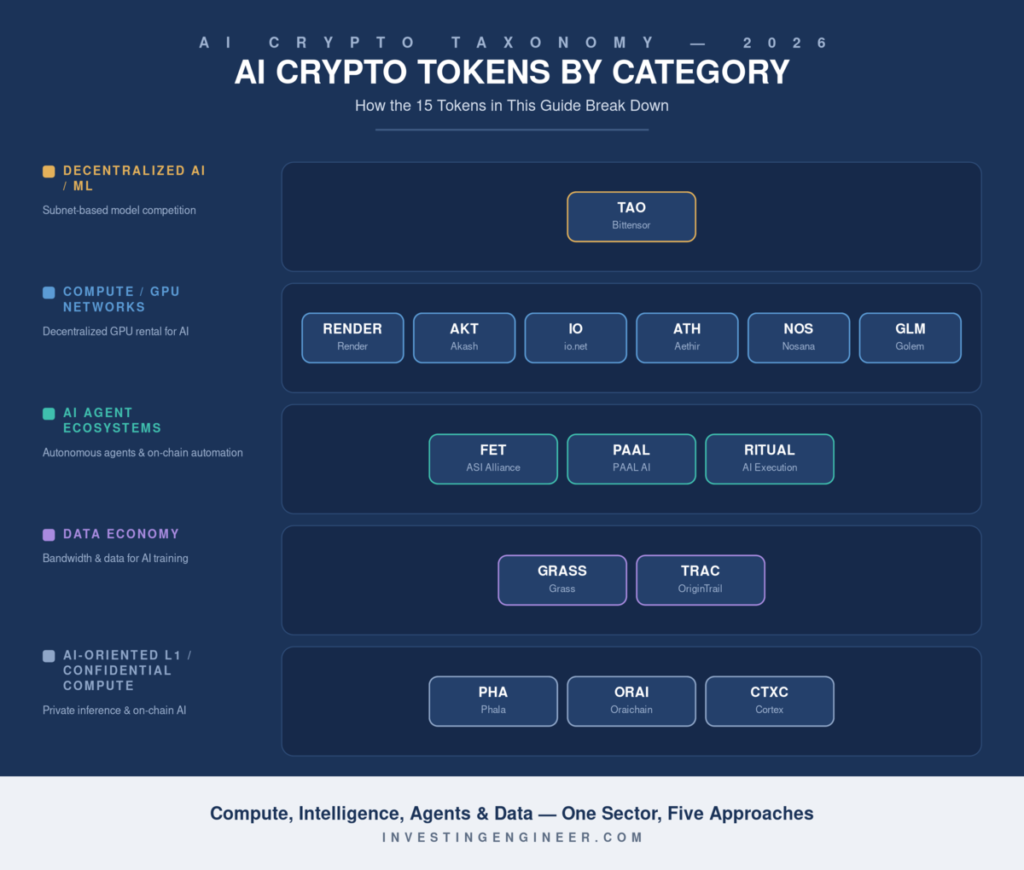
The Four Main Categories of AI Crypto Tokens
- Compute / GPU networks: Marketplaces for renting decentralized GPU power for AI training and inference (Render, Akash, io.net, Aethir, Nosana, Golem).
- Decentralized AI/ML networks: Protocols that coordinate machine learning or model competition across independent participants (Bittensor).
- AI agent ecosystems: Infrastructure for autonomous AI agents that can transact and act on-chain (Artificial Superintelligence Alliance, PAAL AI).
- Data economy tokens: Projects that monetize data collection, labeling, or provenance for AI training (Grass, OriginTrail).
How We Evaluated These Tokens
Rather than ranking by price momentum alone, each project below was assessed against a consistent set of fundamentals:
- Market capitalization and trading liquidity
- Token utility and how the network actually generates value
- Developer activity and roadmap execution
- Ecosystem growth, active users, and network adoption
- Strategic partnerships (enterprise vs. purely retail)
- Tokenomics — is supply tied to real usage, or fixed/inflationary?
- Staking, governance, and competitive advantages
- Institutional interest and security history
- Regulatory considerations
Where price action and usage data have clearly diverged — as with Render and OriginTrail in 2026 — we call that out explicitly rather than letting a rising or falling chart speak for itself.
The Top AI Crypto Tokens to Watch in 2026
1. Bittensor (TAO)
Bittensor is arguably the bellwether of the entire AI crypto sector. Rather than renting out raw GPU power, Bittensor coordinates decentralized machine learning: independent “subnets” compete to produce the best AI outputs for a given task, and TAO emissions reward the subnets performing best. Its market cap has ranged between roughly $2.2 billion and $3.4 billion through 2026, and its subnets generated an estimated $43 million in AI service revenue in the first quarter of the year alone.
In 2026, Bittensor doubled its subnet capacity from 128 to 256 slots in an upgrade nicknamed “Robin τ,” designed to let more AI teams compete for emissions. That growth ambition comes with real concentration risk: when the Covenant AI subnet exited the network in April 2026, TAO’s price dropped roughly 20% in response — a reminder that Bittensor’s modular design means a single subnet’s departure can move the market. On the institutional side, Grayscale and Bitwise have both filed for spot ETFs tied to TAO, which would be a first for a purpose-built AI-crypto asset if approved.
Bottom line: Bittensor has the clearest revenue story in the sector, but its subnet-based architecture makes it more sensitive to individual ecosystem departures than most competitors.
2. Render (RENDER)
Render Network runs on Solana and lets anyone rent out spare GPU power for rendering (originally for visual effects and gaming) and, increasingly, for AI training and inference. Usage metrics have been genuinely strong: cumulative frames rendered reached about 69.4 million in early 2026, up 156% year-over-year, with token burns growing 158% over the same period. The network has real-world credibility too, with GPU capacity powering major music-video visual effects and large-scale immersive exhibits.
Here’s the catch worth flagging clearly: even as usage climbed, RENDER’s token price fell sharply — some 2026 reporting cited an 86% decline from cycle highs even as network activity surged. That divergence is one of the most important lessons in this entire list: strong fundamentals do not automatically translate into a strong token price, especially in a sector this driven by sentiment.
Render remains one of the more credible decentralized-compute plays given its diversified use cases (creative rendering plus AI workloads), but investors should treat the 2026 price-versus-usage gap as a caution sign, not a straightforward buying opportunity.
See How TAO and RENDER Are Trading Right Now
A single subnet exit knocked TAO down roughly 20% in April 2026, while RENDER’s price fell even as usage climbed. Numbers like that change fast — chart both tokens side by side to see where they stand today.
Chart Bittensor vs. Render on TradingView →3. Artificial Superintelligence Alliance (FET / ASI)
The Artificial Superintelligence Alliance is the result of a 2024 merger between Fetch.ai, SingularityNET, and Ocean Protocol (with Ocean later withdrawing in October 2025 amid governance disputes; CUDOS remains part of the alliance). It’s the most ambitious project on this list: in 2026 it’s building a full stack that includes the ASI:One agentic platform, ASI-1 language models, ASI:Cloud decentralized compute, and its own purpose-built Layer 1, ASI:Chain, targeted for mainnet in late 2026 or early 2027.
The alliance hit real 2026 milestones, including a large-scale autonomous agent network deployment in April and an agent launchpad paired with an ASI:Chain testnet in May. FET was trading near $0.21 in late May 2026, with capital rotating back into AI tokens on the back of that agent-infrastructure news.
The risk here is execution and governance: building a merged agentic platform, a family of language models, cloud infrastructure, and a new Layer 1 simultaneously is a lot to deliver, and the alliance has already lost one founding member to a governance dispute. Investors drawn to the AI-agent narrative should watch ASI:Chain’s actual mainnet delivery as the key milestone to judge execution against.
4. Akash Network (AKT)
Akash is a Cosmos-based decentralized cloud compute marketplace that markets itself as 70–85% cheaper than traditional cloud providers. It had a standout first quarter in 2026, posting an all-time high in quarterly compute spend and processing more than 5 billion tokens daily since late April (with a peak single window of about 6.58 billion tokens) — concrete evidence that enterprise and developer usage is scaling.
The bigger story for long-term holders is Akash’s March 2026 activation of a Burn-Mint Equilibrium (BME) model, which ties AKT’s token supply directly to real compute usage on the network, burning tokens based on actual workloads rather than a fixed emissions schedule. This is a direct response to the sector-wide criticism that AI-token supply has historically been disconnected from usage.
Akash’s 2026 roadmap focuses on maturing from a compute marketplace into a fuller enterprise cloud platform — adding secure networking, reserved capacity, and edge AI. Its combination of measurable usage growth and usage-linked tokenomics makes it one of the stronger fundamentals stories in this list.
5. io.net (IO)
io.net is another Solana-based decentralized GPU network, and it made one of the more significant tokenomics changes in the sector in 2026: on June 11, it launched an “Incentive Dynamic Engine” (IDE) that ties IO emissions and burns directly to real network earnings instead of a fixed schedule. Under the new model, at least 50% of surplus revenue (once suppliers are paid) goes toward buying back and burning IO, with a minimum commitment to burn 12 million IO tokens over 12 months.
Around the same time, io.net reported hitting 4 billion daily AI tokens processed and closing an $8 million enterprise deal — tangible signs that the shift to usage-linked tokenomics is happening alongside real demand growth, not instead of it.
For investors, io.net is a useful case study in how the sector is trying to fix its inflation problem: if the IDE performs as designed, it could meaningfully change IO’s long-term supply dynamics, but the model is new and unproven over a full market cycle.
6. Grass (GRASS)
Grass takes a different approach to the AI-compute problem: instead of GPUs, it monetizes unused internet bandwidth. Users install a browser extension or mobile app that turns their device into a “Grass Node,” which helps scrape and structure public web data that AI labs use for training, earning GRASS tokens in return.
The network’s scale is genuinely large for a data-economy project: roughly 2.5 million nodes across 190 countries, with a user base cited as high as 8.5 million in 2026, processing more than 100 terabytes of data daily through its “Live Context Retrieval” engine. GRASS has a capped supply of 1 billion tokens, and a second airdrop season (potentially up to 170 million tokens, or 17% of supply) was under discussion for the second half of 2026.
Grass is one of the clearer bets on the “data economy” thesis within AI crypto — the idea that AI labs will increasingly need to pay for structured, consented data rather than scraping it for free. Its main open questions are long-term demand from AI labs at scale and how upcoming token unlocks/airdrops affect price.
7. Aethir (ATH)
Aethir positions itself as an enterprise-grade decentralized GPU cloud, and its scale backs that up: more than 440,000 containers across 94 countries as of late 2025, reportedly generating around $166 million in annualized revenue in the third quarter of 2025 from AI workloads and cloud gaming.
Its biggest 2026 headline is a roughly $260 million commitment to a cluster of 2,304 Nvidia B300 GPUs, targeted to be fully operational by the first quarter of the year — a scale of hardware investment that stands out even among decentralized-compute peers. Aethir also introduced a “Strategic Compute Reserve” backed by ATH tokens, designed to guarantee GPU availability and stable pricing for enterprise customers during peak demand.
Aethir’s enterprise focus and hardware scale make it one of the more credible “institutional-grade” decentralized compute plays, though as with all GPU-network tokens, its economics depend on sustained enterprise demand rather than just retail speculation.
8. Nosana (NOS)
Nosana is a smaller decentralized GPU marketplace on Solana, with a market cap around $22 million as of March 2026. What stands out is verifiable, if modest, real-world usage: Sogni AI has generated 25 million images using Nosana’s GPUs, and an independent AI security lab (Alio) uses the network to train large language model risk-detection systems and run red-teaming simulations.
Nosana’s 2026 roadmap includes expanding beyond Nvidia hardware to AMD, Intel, and Apple Silicon — broadening its supply of usable compute — plus enterprise features like fiat ramps and billing tools planned for the second half of the year. NOS has a capped maximum supply of 100 million tokens.
As a smaller-cap project, Nosana carries more liquidity risk than the larger names on this list, but its real customer usage and hardware-diversification plans make it worth watching as a higher-risk, higher-upside compute play.
9. OriginTrail (TRAC)
OriginTrail focuses on a different problem entirely: verifiable data. Its Decentralized Knowledge Graph (DKG) lets organizations publish and verify data provenance — relevant to AI because trustworthy, traceable training data and outputs are becoming a bigger concern as AI models scale.
TRAC is also a useful case study in AI-crypto volatility: the token spiked as much as 95% in mid-May 2026, to roughly $0.62, after an exchange (Upbit) announced new trading pair support — only to fall back to around $0.26 (market cap near $118 million) by mid-July. In May 2026, OriginTrail also launched an Obsidian note-taking plugin that lets users publish notes directly into the DKG, aimed at knowledge workers.
OriginTrail’s use case (verifiable data/provenance) is a genuinely important piece of the AI infrastructure puzzle, but its price history in 2026 is a clear example of listing-driven spikes that later reverse — a pattern worth remembering before chasing a sudden rally in any smaller-cap AI token.
10. Phala Network (PHA)
Phala Network takes a privacy-first approach to decentralized AI: it runs AI inference inside Trusted Execution Environments (TEEs), hardware-level secure enclaves that let AI models process sensitive data without exposing it — even to the node operator running the hardware. That’s a meaningfully different value proposition from pure throughput-focused GPU networks, and it opens the door to enterprise and regulated-industry use cases that require data privacy.
In June 2026, Phala added new models to its catalog (including DeepSeek V4 Flash and Qwen updates) and patched a vulnerability that had allowed unauthorized virtual-machine modifications — a useful reminder that newer confidential-compute infrastructure still carries real technical risk. Phala has also pivoted toward Ethereum Layer 2 infrastructure and has ecosystem activity around bringing large language models into production through its confidential-compute stack.
For investors specifically interested in the intersection of AI privacy and enterprise adoption, Phala is one of the more differentiated names on this list — though it remains a smaller, more volatile project than the leading GPU networks.
11. Golem (GLM)
Golem is one of the original “AI on blockchain” style projects, dating back to Ethereum’s early decentralized-compute wave, and it has had to reinvent its value proposition as the market shifted toward LLM-driven GPU demand. Its most notable 2026 development is a pilot (announced in January) to integrate Salad’s roughly $200 million GPU cloud business onto Golem’s network — a meaningful Web2-to-Web3 bridge if it scales. GLM also picked up real-world utility recognition when the Tor Project adopted it as a donation currency in May 2026.
Analyst price expectations for GLM have been modest (roughly $0.10–$0.11 in late-summer 2026 forecasts), reflecting its status as a smaller, more mature project rather than a high-momentum newcomer. Golem is a reasonable name to watch for investors interested in legacy DePIN infrastructure with a credible (if still early) path to renewed relevance through partnerships like Salad.
12. Smaller, Higher-Risk Names to Watch
The following projects have real AI use cases but currently offer thinner, less independently verifiable adoption data than the names above. They’re worth knowing about, but they carry meaningfully higher liquidity and execution risk.
Oraichain (ORAI): An “AI x blockchain” project whose live Quant Terminal product had reported over 800 active users and about $68 million in cumulative trading volume shortly after launch. Its 2026 roadmap focuses on expanding that terminal and deepening modular DeFi integrations.
PAAL AI (PAAL): Offers customizable AI agents integrated with Web3 tools for automation and monetization. Smaller-cap, with less independently verifiable adoption data than the compute-network leaders.
Cortex (CTXC): One of the earliest “AI on blockchain” projects, offering a Cortex Virtual Machine for on-chain AI inference via smart contracts. Activity and market attention are markedly lower than newer DePIN projects — treat as a legacy, higher-risk small-cap.
Ritual: Positions itself around infrastructure for on-chain AI execution and AI agents. Earlier-stage, with limited independently verifiable 2026 usage data compared with the established GPU networks.
Side-by-Side Comparison Table
| Token | Category | Primary Use Case | Blockchain | Staking | 2026 Tokenomics Note |
|---|---|---|---|---|---|
| Bittensor (TAO) | Decentralized AI/ML | Competitive subnet-based model training | Bittensor (own chain) | Yes | Subnet capacity doubled to 256; ETF filings pending |
| Render (RENDER) | Compute / GPU | Decentralized GPU rendering & AI compute | Solana | Yes | Burns tied to network usage; frames rendered +156% YoY |
| Artificial Superintelligence Alliance (FET) | AI Agents | Agentic platform, LLMs, decentralized compute | Own L1 (ASI:Chain, in progress) | Yes | Merger of 3 projects; ASI:Chain mainnet targeted late 2026/2027 |
| Akash Network (AKT) | Compute / GPU | Decentralized cloud compute marketplace | Cosmos | Yes | Burn-Mint Equilibrium ties supply to real compute usage |
| io.net (IO) | Compute / GPU | Decentralized GPU network for AI workloads | Solana | Yes | Incentive Dynamic Engine: usage-linked emissions/burns |
| Grass (GRASS) | Data Economy | Bandwidth-for-data AI training network | Solana | Limited | Capped 1B supply; Season 2 airdrop discussed for H2 2026 |
| Aethir (ATH) | Compute / GPU | Enterprise-grade decentralized GPU cloud | Own chain (Arbitrum-based) | Yes | Strategic Compute Reserve; ~$260M B300 GPU cluster planned |
| Nosana (NOS) | Compute / GPU | Affordable decentralized GPU rental | Solana | Yes | Capped 100M supply; expanding beyond Nvidia hardware |
| OriginTrail (TRAC) | Data Economy | Decentralized Knowledge Graph for data provenance | NeuroWeb / multichain | Yes | High listing-driven volatility observed in 2026 |
| Phala Network (PHA) | AI-Oriented L2 / Confidential Compute | Private AI inference via TEEs | Ethereum L2 | Yes | Pivoted to Ethereum L2; new model catalog additions in 2026 |
| Golem (GLM) | Compute / GPU | Legacy decentralized compute marketplace | Ethereum | No | 2026 pilot integrating Salad’s GPU cloud business |
| Oraichain (ORAI) | AI-Oriented L1 | AI oracle & DeFi/AI tooling (Quant Terminal) | Cosmos / multichain | Yes | Early-stage product traction (~800 active users) |
| PAAL AI (PAAL) | AI Agents | Customizable AI agents for Web3 | Multichain | Limited | Smaller-cap; less independently verifiable adoption data |
| Cortex (CTXC) | AI-Oriented L1 | On-chain AI inference via smart contracts | Own chain | Yes | Legacy project; lower activity than newer DePIN peers |
| Ritual | AI Agents / Compute | Infrastructure for on-chain AI execution | Multichain | Varies | Earlier-stage; limited independently verifiable 2026 data |
Build Your AI Crypto Watchlist in One Click
Fifteen tokens, one table — but market caps and usage data shift daily. Load TAO, RENDER, FET, AKT, IO, GRASS, ATH, NOS, TRAC, and PHA into a single watchlist so you can see how today’s comparison changes, free to start.
Create an AI Crypto Watchlist on TradingView →Where’s the Institutional Money Going?
Institutional engagement with AI crypto in 2026 shows up in two places. First, capital allocation: roughly 40 cents of every crypto venture-capital dollar invested in 2025 went to firms also building AI products, up from about 18 cents a year earlier, as total crypto VC funding rose to about $7.9 billion (up 44% year-over-year). Second, public-market access: Grayscale and Bitwise have both filed for spot ETFs tied to Bittensor’s TAO, which — if approved — would give traditional investors regulated exposure to a specific AI-crypto asset for the first time.
It’s worth keeping this in perspective, though. Institutional interest remains concentrated in a handful of larger, more liquid names (Bittensor, Render, the Artificial Superintelligence Alliance, Akash) rather than spread evenly across the sector. And broader institutional AI infrastructure spending — hyperscalers like Microsoft and Meta alone are projected to commit more than $300 billion in capex in 2026 — still dwarfs the entire AI-crypto market. Decentralized AI compute remains a small, early-stage complement to centralized AI infrastructure, not a replacement for it.
AI Crypto Sector by the Numbers
| Metric | Figure | Approx. Date |
|---|---|---|
| AI-crypto sector combined market cap | ~$20.9B–$25B | Apr–Jun 2026 |
| Number of tracked AI-crypto projects | ~900–919 | Apr 2026 |
| AI-crypto sector TVL | ~$8.2B (+340% YoY) | Q1 2026 |
| Crypto VC total funding (2025) | ~$7.9B (+44% YoY) | 2025 |
| Share of crypto VC $ also building AI products | ~40% (vs. ~18% prior year) | 2025 |
| Average AI-token H1 2026 drawdown | ~65% (vs. ~30% for BTC) | H1 2026 |
| Akash Q1 2026 compute spend | All-time high (~$5M) | Q1 2026 |
| io.net daily AI tokens processed | ~4B/day | Mid-2026 |
| Render cumulative frames rendered | ~69.4M (+156% YoY) | Early 2026 |
Figures are approximate and time-sensitive. Verify against live sources (CoinGecko, CoinMarketCap, DefiLlama, Messari, Artemis) before making any investment decision.
Bullish vs. Bearish Case for AI Crypto in 2026
The Bullish Case
- Real, measurable compute demand growth — Akash’s record quarterly spend, io.net’s 4 billion daily AI tokens processed, and Render’s frame-rendering growth all show usage isn’t purely theoretical.
- Tokenomics upgrades (Akash’s Burn-Mint Equilibrium, io.net’s Incentive Dynamic Engine) directly address the long-standing criticism that token supply wasn’t tied to real usage.
- Institutional access is expanding, with TAO ETF filings potentially bringing new capital and legitimacy to the sector.
- Enterprise-grade hardware deals, like Aethir’s B300 GPU cluster commitment, suggest the sector is moving beyond retail-only participation.
The Bearish Case
- AI-token volatility has run roughly double Bitcoin’s in 2026, and price action often diverges sharply from usage growth, as seen with Render.
- Governance and ecosystem fragility: the Artificial Superintelligence Alliance losing a founding member, and Bittensor’s subnet-exit price shock, both show these networks can be destabilized by a single participant leaving.
- Regulatory frameworks haven’t caught up to the AI-plus-crypto intersection, creating uncertainty.
- Centralized AI infrastructure — backed by hundreds of billions in hyperscaler capex — could out-execute decentralized alternatives on reliability and scale.
- Some smaller projects have limited independently verifiable adoption data, with pricing dominated by speculation and thin liquidity.
Risks of Investing in AI Crypto Tokens
- Extreme volatility, with deeper average drawdowns than Bitcoin in 2026
- AI-narrative speculation disconnected from actual revenue or usage
- Token inflation in projects that haven’t yet adopted usage-linked burn models
- Intensifying competition, both within the sector and from centralized cloud/AI providers
- Regulatory uncertainty around the AI-crypto intersection specifically
- Execution risk on ambitious roadmaps, such as the Artificial Superintelligence Alliance’s ASI:Chain
- Security vulnerabilities — even newer infrastructure like Phala’s TEE stack has needed emergency patches
- Liquidity risk in smaller-cap names
- Dependence on continued broad AI adoption and enterprise capex
- Market-cycle sensitivity, with limited diversification benefit during broader risk-off periods
Want Exposure to AI Crypto Volatility Without Holding the Token?
AI-crypto tokens saw roughly double Bitcoin’s average drawdown in the first half of 2026. If you’re interested in trading that volatility rather than holding spot tokens long-term, Pepperstone offers crypto CFDs — a different risk profile worth understanding before you use it. As with any leveraged product, make sure you understand the risks before committing capital.
Explore Crypto CFDs with Pepperstone →How to Evaluate an AI Crypto Token Beyond the Hype
Before putting money into any AI crypto token, it helps to run through a short checklist:
- Usage over price: Look for real metrics — compute spend, active nodes, daily volume processed, enterprise deals — rather than relying on price charts alone.
- Tokenomics design: Understand whether token supply is tied to usage (like Akash’s or io.net’s 2026 models) or still runs on a fixed, potentially inflationary emissions schedule.
- Concentration risk: Ask whether the network’s value depends heavily on one or two subnets, partners, or customers that could leave.
- Track record on execution: Compare what a project promised on its roadmap against what it has actually shipped.
- Regulatory exposure: Consider how exposed the project might be as AI and crypto regulation continues to evolve.
If you want to track these metrics and price action for the tokens covered here as they evolve, a charting platform like TradingView can help you set up watchlists and alerts across multiple AI crypto tokens in one place — useful for keeping tabs on a fast-moving sector without checking a dozen separate sites.
Track Usage Metrics, Not Just Price
The whole point of this section is that price and fundamentals can diverge — Render proved that in 2026. Set up price alerts and compare each token’s chart against its own usage narrative so you’re reacting to data, not headlines.
Set Up AI Crypto Alerts on TradingView →Frequently Asked Questions
What are AI crypto tokens?
AI crypto tokens are cryptocurrencies tied to blockchain projects that combine AI with decentralized infrastructure — most commonly decentralized GPU compute, AI data collection, or autonomous AI agents. The token is typically used to pay for network services, reward contributors, and sometimes vote on governance.
Why are AI cryptocurrencies attracting investors?
Rising demand for AI compute, high-profile institutional moves like the Bittensor ETF filings, rapid sector growth (TVL up roughly 340% year-over-year into Q1 2026), and investor appetite for a crypto-native way to gain exposure to the AI boom.
Which AI tokens have the strongest ecosystems right now?
Based on 2026 usage data, Bittensor, Render, Akash Network, and Aethir show the clearest evidence of real network activity — compute spend, rendered output, and enterprise deals. The Artificial Superintelligence Alliance has the boldest roadmap but carries more execution and governance risk.
How do AI crypto projects generate value?
Mostly by charging for compute, data, or agent services in their native token, with a growing number of projects (Akash, io.net) now burning or buying back tokens based on actual usage rather than a fixed emissions schedule.
What are the biggest risks of investing in AI crypto?
Extreme volatility (AI tokens saw roughly double Bitcoin’s average drawdown in the first half of 2026), valuations driven by narrative rather than usage, regulatory uncertainty, competition from centralized AI infrastructure providers, and concentration risk — a single subnet or partner leaving can move a token’s price significantly.
How should I evaluate an AI token beyond the hype?
Check verifiable usage metrics (compute spend, active nodes or users, revenue), how tokenomics work (is supply tied to usage, or fixed and inflationary?), developer activity, the quality of partnerships (enterprise versus purely retail), and whether the token’s price has tracked or diverged from actual network growth.
Are AI crypto tokens a good long-term investment?
This is a highly speculative, early-stage sector. Fundamentals-driven exposure to established projects with verifiable usage may appeal to risk-tolerant investors with a long time horizon, but AI crypto tokens are best sized as a small, high-risk allocation rather than a core holding. This isn’t financial advice — do your own research and consider speaking with a licensed financial advisor before investing.
Final Thoughts: Next Steps for Investors
The best AI crypto tokens to watch this year are the ones backed by verifiable usage — real compute spend, real enterprise deals, and tokenomics that hold up under scrutiny — rather than the ones simply riding the loudest narrative. Bittensor, Render, Akash, io.net, and Aethir currently show the clearest evidence of real network activity, while projects like the Artificial Superintelligence Alliance and Grass offer bigger upside alongside bigger execution or adoption risk.
Whatever you decide, size any AI crypto position as a small, high-risk allocation, keep tracking usage data (not just price), and stay alert to the sector’s history of sharp listing-driven spikes and reversals.
This article is for informational and educational purposes only and does not constitute financial advice. Cryptocurrency markets are highly volatile and speculative. Always do your own research and consider speaking with a licensed financial advisor before making any investment decision.
Disclosure: The content on this page was produced with AI writing assistance under the editorial direction of a licensed Electrical Engineering practitioner and certified investor in different markets with over a decade of experience. All articles are reviewed and approved by the author before publication.
