
Andy Burnham is now the United Kingdom’s Prime Minister. He replaced Sir Keir Starmer, who resigned on June 22, 2026, after a rough few months for Labour: disappointing local election results, falling poll numbers, and open frustration from Labour MPs. Burnham then won the Labour leadership contest with the backing of roughly 349 MPs — about 85% of the parliamentary party — and was confirmed as leader on July 17, 2026, putting him on track to be formally appointed Prime Minister by the King within days.
If you invest in UK stocks, hold a FTSE-tracking ETF, own UK government bonds, or simply keep an eye on the British pound, the political headlines matter less than what comes next.
This article sets aside the political drama and focuses on what Andy Burnham’s premiership actually means for your portfolio: his fiscal philosophy, how gilt yields and sterling have already reacted, which sectors look like winners and losers, and what to watch over the coming weeks and months.
Key Takeaways for Investors
- Burnham becomes PM through the normal workings of the UK’s parliamentary system, not a general election — this is procedurally routine, even if the frequency of UK leadership changes (seven PMs in a decade) is not.
- His Chancellor pick and first fiscal statement will matter far more to markets than anything said on the campaign trail.
- Gilt yields spiked sharply in May 2026 on pure leadership speculation, then eased after Burnham explicitly committed to Rachel Reeves’s existing fiscal rules.
- Sector reaction has already been uneven: housebuilders have rallied, while water utilities and banks have come under pressure on nationalization and tax speculation.
- The IMF has warned Burnham directly that the 2022 Liz Truss mini-budget crisis left lasting scar tissue in UK bond markets — a warning shaping his early, deliberately cautious fiscal rhetoric.
- The FTSE 250, which is more domestically focused, has shown more sensitivity to Burnham-specific policy risk than the internationally-earning FTSE 100.
Who Is Andy Burnham?
Andy Burnham, 56, is not a political newcomer. He has spent nearly three decades in and around UK politics and government, giving investors a reasonably long track record to assess — unlike a true outsider taking office for the first time.
Political Career
Burnham was first elected as an MP for Leigh in 2001. Under the Blair and Brown governments he held several ministerial posts, including Chief Secretary to the Treasury and, notably, Health Secretary — giving him direct experience managing large public budgets. He later left Westminster to become Mayor of Greater Manchester in 2017, a role he has held ever since. In that job, he built a reputation as a pragmatic, business-engaged regional leader rather than a purely ideological figure.
“Manchesterism” and His Track Record as Mayor
Burnham describes his governing philosophy as “Manchesterism” — which he has characterized as “business-friendly socialism.” As mayor, this translated into concrete projects: the Bee Network, Manchester’s publicly controlled bus system, and the Good Growth Fund, which channeled investment into each of Greater Manchester’s boroughs. For investors, the throughline is a preference for public investment and regional infrastructure spending, paired with an explicit effort to stay on good terms with business and investors rather than alienate them.
Why Does the UK Have a New PM Without an Election?
This is arguably the single most common question from outside the UK, and the answer is simpler than it looks.
How Starmer’s Resignation Led Here
Keir Starmer won a landslide general election victory for Labour in 2024. Less than two years later, poor results in the May 2026 local elections, sliding opinion poll numbers, and mounting criticism from Labour’s own MPs pushed him to resign as party leader and Prime Minister on June 22, 2026.
Health Secretary Wes Streeting, who had enough support to run himself, stepped aside to let Burnham consolidate the leadership, which he secured with an overwhelming majority of Labour MPs behind him.
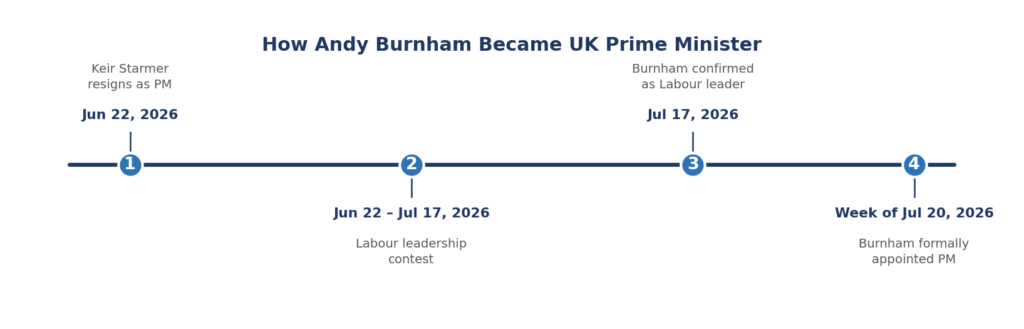
How Andy Burnham became UK Prime Minister, June–July 2026
How the Westminster System Works
In the UK, voters elect Members of Parliament, not the Prime Minister directly. The leader of whichever party can command a majority in the House of Commons becomes Prime Minister.
When a sitting PM resigns mid-term, as Starmer did, the governing party simply elects a new leader — who then becomes PM without any general election being required.
This is not unusual: five of the UK’s last seven prime ministers took office this way rather than by winning a general election outright. Burnham is simply the latest example, and the UK’s seventh PM in a decade.
Burnham’s Economic and Fiscal Philosophy
For investors, Burnham’s specific tax and spending positions matter far more than his biography.
Tax Plans: Wealth Tax, Land Value Tax, and Capital Gains
Burnham has explicitly ruled out a broad wealth tax as an immediate, first-order priority — a signal widely read by investors and businesses as reassurance that his government won’t move abruptly on the most feared tax option.
That said, he has long argued that the UK taxes earned income too heavily relative to accumulated wealth, land, and property. He has specifically floated a land value tax, which he has suggested could allow for the reduction or even abolition of stamp duty. Capital gains tax and inheritance tax reform are also seen as more likely areas of change than a blanket wealth levy.
Spending, Borrowing, and Fiscal Rules
The critical swing factor for markets is whether Burnham keeps the fiscal rules established by outgoing Chancellor Rachel Reeves — rules designed specifically to reassure bond markets after the 2022 Truss crisis. In his first major policy speech since becoming Labour leader, Burnham explicitly tied his agenda to “the discipline of our current fiscal rules,” a statement that markets read as reassuring.
Bloomberg reports that Reeves herself has indicated she expects to be replaced as Chancellor, with Home Secretary Shabana Mahmood the reported front-runner, alongside Ed Miliband, Yvette Cooper, and Wes Streeting as other names in the mix.
CNBC notes that the Chancellor choice is one of the biggest sources of uncertainty for big business heading into the transition. Whoever gets the job, and what they say in their first fiscal statement, will be the clearest real-world test of how much Burnham’s fiscal rhetoric matches his fiscal policy.
How Markets Have Reacted So Far
Gilt Yields and the Pound
UK government bonds, known as gilts, are the clearest early market signal. CNBC reported that in May 2026, as Burnham’s leadership bid gained momentum, the 10-year gilt yield jumped to roughly 5.137% — its highest level since 2008 — while the 30-year yield rose above 5.8%, a level last seen in 1998.
That spike happened on pure speculation, before Burnham had said much about specific policy. Sentiment improved somewhat after his fiscal-rules speech: 30-year gilt yields eased about 2 basis points and the pound rose roughly a third of a cent to around $1.3240 against the US dollar.
As Bloomberg Opinion put it, bond markets treated Burnham as a meaningful risk premium when his rise looked likely, and only partially relaxed once he explicitly signaled fiscal continuity.
Watch Gilt Yields and Sterling Move in Real Time
The 10-year gilt yield and GBP/USD have already swung sharply on pure leadership speculation. A live chart lets you see the next move as it happens, rather than reading about it the next morning.
Chart UK Gilt Yields & GBP/USD on TradingView →FTSE 100 vs. FTSE 250
Stock market reaction has been more nuanced than a simple “risk-on” or “risk-off” move. On the day Burnham was confirmed as Labour leader, the FTSE 100 rose 0.3% to 10,600.4 points, lifted by energy and utility names tracking higher oil prices, while the mid-cap FTSE 250 — which is more exposed to the domestic UK economy — fell 0.5%, snapping a six-day winning streak, according to Reuters.
That divergence matters: the FTSE 100 is dominated by internationally-earning multinationals that are less sensitive to UK-specific policy, while the FTSE 250 is a better barometer of how investors actually feel about the UK’s domestic policy direction under Burnham.
See How the FTSE 100 and FTSE 250 Are Diverging
The FTSE 100 and FTSE 250 haven’t been moving together since Burnham’s rise began — a useful signal for how markets are actually pricing UK-specific risk. Compare both indexes side by side to see the gap for yourself.
Compare the FTSE 100 vs. FTSE 250 on TradingView →Sector Winners and Losers Under a Burnham Government
Based on early market reaction and analyst commentary, here’s how different UK sectors are being positioned so far:
| Sector | Early Direction | Why |
|---|---|---|
| Housebuilders (Vistry, Barratt Redrow, Taylor Wimpey, Persimmon) | Mixed, tilted positive | Shares rose up to 4% on an ambitious housing agenda; Vistry and Mears (affordable/social housing focus) look better positioned than pure volume builders facing margin pressure from stricter affordable-housing requirements |
| Water utilities (Severn Trent, United Utilities) | Negative | Down roughly 1.5% on nationalization and tighter-regulation speculation |
| Banks (HSBC, Barclays, Lloyds, NatWest) | Cautious | Down about 0.4% on leadership news, with brokerages down further, amid windfall-tax speculation |
| Energy and utilities (National Grid, SSE) | Positive | Benefiting from both an oil-driven sector rotation and Burnham’s infrastructure and green-investment agenda |
| Infrastructure, rail, construction (Balfour Beatty, Kier Group) | Positive | Direct beneficiaries of devolution-led regional infrastructure spending under the “No. 10 North” plan |
| Defense (BAE Systems, Rolls-Royce) | Neutral to positive | Foreign policy continuity on NATO and Ukraine support suggests limited disruption to the defense spending trajectory |
Is This “Another Liz Truss”?
Lessons From the 2022 Mini-Budget Crisis
In 2022, Liz Truss’s government proposed roughly £45 billion in unfunded tax cuts. The reaction was severe: the pound tumbled, gilt yields spiked, and the Bank of England had to step in and buy about £65 billion of government bonds to stabilize the market. Truss lasted just 49 days in office, the shortest tenure of any UK Prime Minister. In an ironic twist, Truss herself has publicly predicted that Burnham will trigger a “financial crisis” — a claim widely noted for the irony given her own record.
What’s Different This Time
The International Monetary Fund (IMF) has told Burnham directly, as first reported by Bloomberg, that the Truss episode caused a lasting “regime shift” in how bond markets price UK fiscal risk — in other words, gilt investors are now permanently more jumpy about any hint of unfunded spending or tax cuts, from any party.
That backdrop is precisely why Burnham’s early messaging has leaned so heavily on continuity with Reeves’s fiscal rules rather than a fresh, unfunded agenda. The key difference from 2022: Truss announced a specific, large, unfunded package that spooked markets in real time; Burnham, so far, has spoken in generalities and repeatedly signaled fiscal discipline. Whether that holds through his first actual budget is the real test.
The Bank of England Relationship
Independence and a Possible Dual Mandate
The Bank of England has operated independently of the government on interest-rate policy since 1997, a legacy of the Blair-Brown years widely viewed as a pillar of UK economic credibility. As that 30th anniversary approaches, some in Burnham’s circle have floated re-examining the Bank’s mandate — potentially adding a growth objective alongside its current inflation-only mandate, similar to the US Federal Reserve’s dual mandate of price stability and employment.
However, Burnham and his likely Chancellor are expected to be cautious about anything that looks like compromising Bank independence, given how central that independence is to the UK’s post-Truss credibility with bond markets.
ING notes that falling oil prices are an incidental tailwind for both Burnham and the Bank of England, easing inflation pressure just as he takes office. As of June 2026, the Bank’s Monetary Policy Committee had held its benchmark rate at 3.75% for a fourth consecutive month, with inflation forecast to average around 2.3% for the year, per HM Treasury’s July 2026 economic forecasts.
The Institute for Fiscal Studies has separately cautioned that the UK is “navigating narrow paths” fiscally, with public sector net debt at roughly 95.1% of GDP — the backdrop against which any Burnham fiscal statement will be judged.
Foreign Policy and International Investors
The US, EU, and China
Burnham has said comparatively little about the foreign policy issues that dominated much of Starmer’s time in office. Analysts expect broad continuity: relations with the US and the Middle East are likely to remain largely unchanged from Starmer-era positions, which are mainstream within the Labour Party.
Interestingly, some observers note that Burnham’s more regionally focused, less overtly pro-European rhetoric could paradoxically align UK economic and security policy more closely with the EU in practice. On China, Burnham has taken a primarily economic rather than confrontational approach — he met with a Chinese consul in April 2026 to discuss cooperation on green development, electric buses, advanced manufacturing, and life sciences.
NATO and Ukraine
Foreign Secretary Yvette Cooper has publicly stated that Burnham is “100% behind” continued UK support for Ukraine and firmly committed to NATO. He has also launched an “Unbroken Cities Network” connecting Manchester, Liverpool, and Lviv to support Ukrainian reconstruction efforts — a sign that, whatever changes domestically, continuity on Ukraine and core alliance commitments looks like the base case for international investors.
Historical Comparison: How UK Leadership Transitions Have Moved Markets
Context helps calibrate expectations. Here’s how Burnham’s arrival compares with recent UK leadership transitions:
| Transition | Market Reaction | Investor Lesson |
|---|---|---|
| Blair (1997) | Calm; markets welcomed fiscal discipline and new Bank of England independence | Credible institutions can offset the uncertainty of a new government |
| Truss (2022) | Severe; gilt yields spiked, pound fell, BoE forced to intervene | Unfunded fiscal announcements can trigger rapid, severe bond-market repricing |
| Sunak (2022) | Calming; seen as a fiscally cautious corrective to Truss | Markets reward explicit commitments to fiscal discipline after a shock |
| Starmer (2024) | Muted; landslide election outcome was well-telegraphed | Expected, rules-based transitions of power carry less market risk than surprise resignations |
| Burnham (2026) | Mixed; gilt yields spiked on speculation, then eased after fiscal-rules pledge | Markets are now pricing UK political risk more sensitively post-Truss, rewarding early credibility signals |
Frequently Asked Questions
Who is Andy Burnham?
Andy Burnham is a veteran Labour politician who served as Health Secretary and Chief Secretary to the Treasury under Blair and Brown, and has been Mayor of Greater Manchester since 2017. He became UK Prime Minister in July 2026, succeeding Keir Starmer.
Why does the UK have a new Prime Minister without a general election?
Because the UK is a parliamentary democracy: voters elect MPs, and the leader of the majority party in the House of Commons becomes Prime Minister. When Starmer resigned as Labour leader, Burnham’s win in the internal leadership contest made him PM automatically, without a national vote.
Will taxes go up under Burnham?
He has ruled out an immediate, broad wealth tax, but has signaled openness to land value tax reform and shifting more of the tax burden onto assets and capital gains rather than earned income. Specifics depend heavily on his Chancellor pick and first fiscal statement.
Will the British pound weaken?
Initial reaction was cautiously positive after Burnham’s commitment to existing fiscal rules, with sterling ticking up to around $1.3240. However, the pound remains highly sensitive to any signal that fiscal discipline is being loosened.
Is this another Liz Truss moment?
The IMF has explicitly flagged that risk, and gilt yields did spike sharply on speculation about Burnham’s rise. But unlike Truss, who announced a specific unfunded tax-cut package, Burnham has so far emphasized continuity with existing fiscal rules. The real test comes with his first budget.
Which UK stocks are most exposed to this transition?
Housebuilders, banks, and water utilities have shown the clearest near-term policy sensitivity so far. Infrastructure, construction, and regional-investment beneficiaries look like the clearest structural winners from Burnham’s devolution agenda.
Related Reading
UK Bank Earnings Season 2026: What to Watch From Lloyds, Barclays, and NatWest
BP vs. Shell: Which Oil Major Has the Better Dividend Right Now?
Rolls-Royce H1 2026 Results Preview: What to Expect on July 30
What Should Investors Do Now?
Rather than reacting to political headlines, it helps to think about a Burnham government across three time horizons.
Short term (0–3 months): Watch the Chancellor appointment and initial fiscal signals closely — these will move gilts and sterling more than anything said during the leadership contest. Expect continued sector rotation as investors price in specific policy announcements rather than general political risk.
Medium term (3–12 months): The first budget or major fiscal statement is the critical event. Watch for confirmation (or abandonment) of Reeves-era fiscal rules, any land value tax or capital gains proposals, and details on housing and devolution funding — all of which will determine whether early market optimism is justified.
Long term (1–5 years): The bigger question is whether Burnham can improve UK productivity, attract investment, and sustain growth while maintaining fiscal credibility with bond markets still scarred by the Truss episode. Investors should focus on concrete policy execution — actual budgets, actual legislation — rather than campaign rhetoric or political narratives.
For investors who want to track these developments in real time, platforms like TradingView make it straightforward to monitor gilt yields, GBP/USD, and FTSE index levels alongside news flow as Burnham’s policy agenda takes shape. Active traders positioning around specific fiscal announcements may also want to keep an eye on sterling volatility through a broker such as Pepperstone, given how sharply the pound has already moved on political headlines alone.
Fiscal Announcements Move Sterling Fast
The pound has already moved on speculation alone, and Burnham’s first fiscal statement could do it again. If you’re interested in how that kind of volatility plays out in FX markets, Pepperstone lets you follow and trade the action as it unfolds. As with any trading decision, understand the risks before committing capital.
Explore Pepperstone →Conclusion and Next Steps
Andy Burnham’s arrival in Downing Street is procedurally unremarkable — just the UK’s parliamentary system doing what it always does — but its market implications are genuinely uncertain. Early signals are more reassuring than alarming: gilt yields have eased from their May 2026 highs, sterling has ticked up, and Burnham has gone out of his way to commit to existing fiscal rules rather than repeat the unfunded-spending mistakes of the Truss era. At the same time, sector reaction shows real differentiation — housebuilders up, utilities and banks under pressure — and the IMF’s direct warning about lingering bond-market sensitivity is not something to dismiss.
The most useful thing investors can do now is resist overreacting to political headlines and instead track the concrete signals: who becomes Chancellor, what the first fiscal statement says, and how gilt yields and sterling respond. Those, far more than any speech, will determine whether a Burnham government is a manageable transition or a repeat of 2022’s turmoil.
Keep This Story Current
The real test comes with Burnham’s first Chancellor pick and fiscal statement. Build a simple watchlist for UK gilt yields, GBP/USD, and the FTSE 100/250 now, so you’re ready when the next major announcement lands.
Build a UK Markets Watchlist on TradingView →Disclosure: The content on this page was produced with AI writing assistance under the editorial direction of a licensed Electrical Engineering practitioner and certified investor in different markets with over a decade of experience. All articles are reviewed and approved by the author before publication.
