
One of the smartest thing to do when the stock market is going down is to re-balance your portfolio in order to return the percentage weight of your investments on how they were allocated based on your risk profile.
Now, why do we really need to re-balance our investments?
If you’re familiar with the phrase, “Past performance is not always an indication of future performance.”, you’ll agree with me that this is true. Most beginner investors think that stocks always go up that’s why these “new” investors base their investing decision on stocks or funds that are last year’s winners. This is not a bad idea so to speak assuming stock price ALWAYS goes up. But what if stocks plummet like the one we are experiencing right now? As of last friday, the PSE index lost 46.98 points and closed to 7,051.78. Remember the time that it reached 8,000.00+ points on April? If you bought on those peak times, then definitely your portfolio is bloody red right now. To put it in another perspective, your last year’s gains may well be your this year’s losses if you remain heavily invested without re-balancing. Now, by re-balancing your portfolio, you put yourself in a position where you minimize losses when the stocks plummet, or you maximize gains when stocks rise. Let’s look at this example below;
Let’s assume that we invested Php 100,000.00 on 3 stocks namely A, B and C on the first year. At the end of the second year, let’s say that Stock A appreciates by 10%, Stock B, appreciates by 2% and Stock C loses 8%. Now let’s compare what happens on a re-balanced portfolio versus an ignored one.
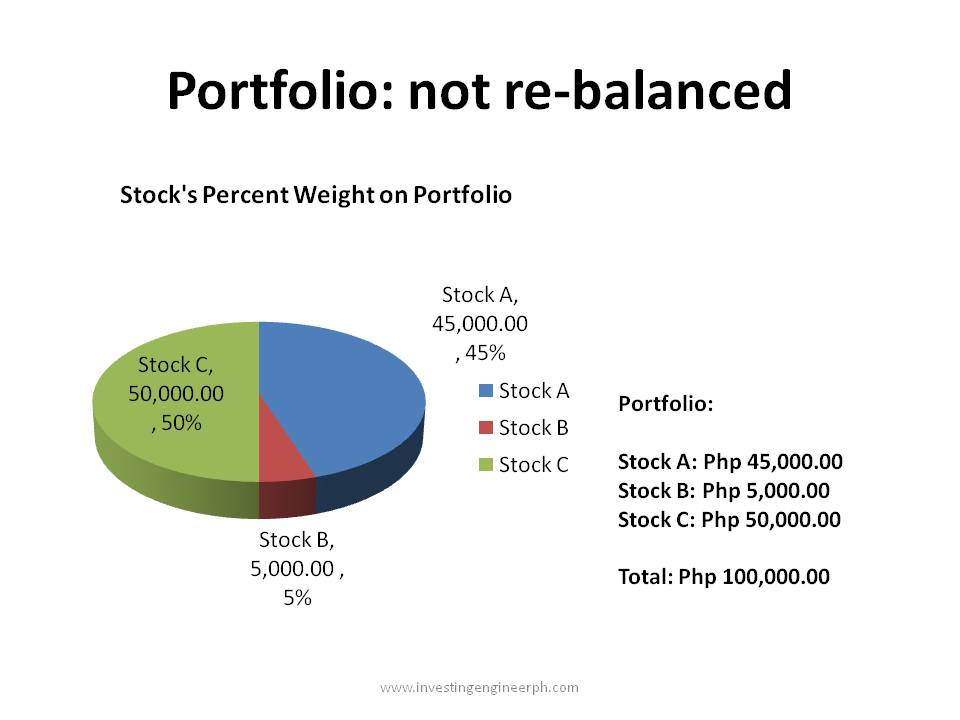
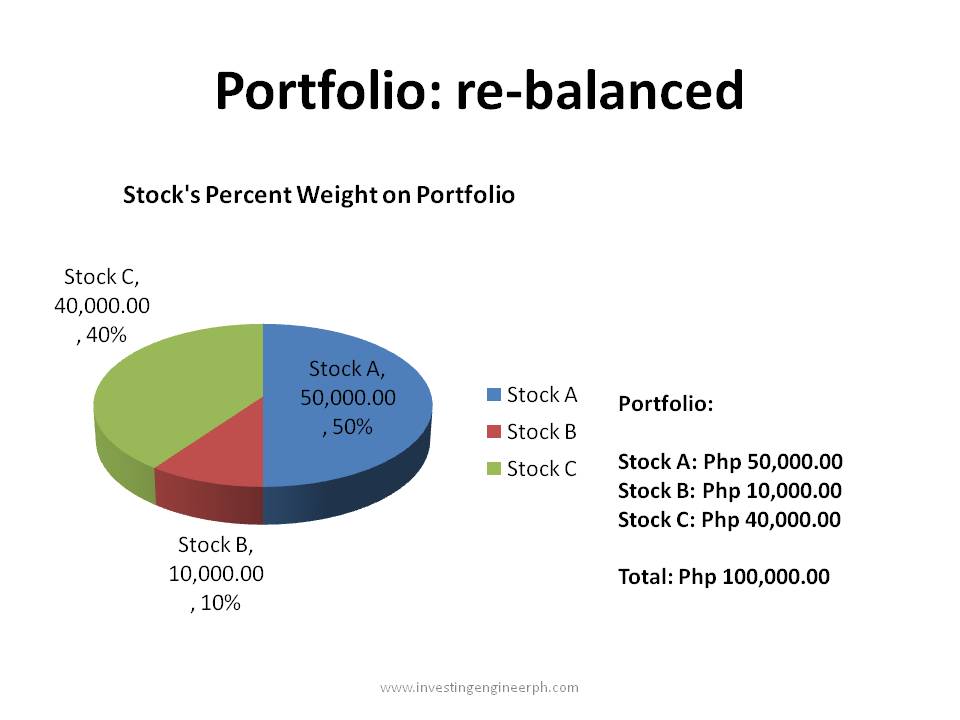
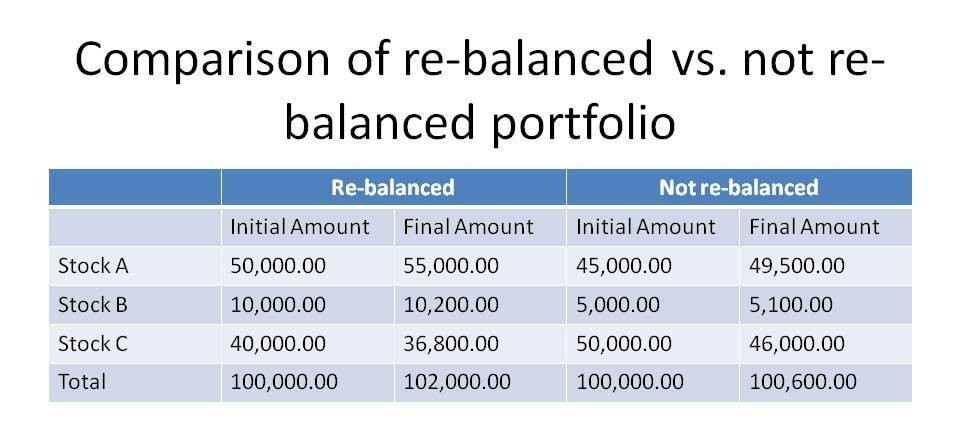
If we look into the figures, we can see that if we re-balanced our portfolio on the beginning of the 2nd year, our portfolio would gain 2% or Php 2,000.00 compared to the ignored portfolio which only gained 0.6% or Php 600.00. Now, assuming all the stocks rallied and gained, the ‘not-re-balanced’ portfolio may gain more compared to the ‘re-balanced’ portfolio. This is what I’m trying to say in my first statement that when stocks decline in value, it’s wiser to re-balance it rather than leave it unchanged.
How to re-balance your portfolio the NORMAL way?
Here’s a step by step plan on how to re-balance your portfolio the normal way:
- One of the first things to do is to plan how much risk you are willing to take on a stock and decide how much weighted percentage will that stock comprise your overall portfolio. After you bought your stocks, you should keep a record and this record will be used as a historical record for the years to come.
- Choose a future date, let’s say every year, to review the current values of each of your stocks and their percentage weight based on your overall portfolio.
- Now, let’s say a year has passed, what we now do is to compare the figures on last year’s percentage weights.
- If there are large significant changes, liquidate some of your stocks to transfer the equity from the other stocks based on your investment strategy.
- If there are no significant changes, you can leave it as is. Take note that when sudden market drops happens before you reach your future date, you should consider taking a look to see if it will cause a great impact on your portfolio.
Now, how to re-balance your portfolio the EASY way?
If you’re a member of PinoyInvestor, there’s a much easier way on how to re-balance your portfolio. By knowing what stocks the Top 13 Mutual Funds and Unit Investment Trust Funds in the Philippines in this exclusive report, you can compare your own portfolio to these funds and adjust or re-balance it if deemed necessary.
Here’s a sneak preview of ATRKE Equity Opportunity Fund’s portfolio that’s included in this exclusive report. If you hold the same stocks as ATRKE, you can adjust and re-balance your portfolio the same way as ATRKE’s.
| ATRKE Opportunity Fund’s Top 10 Stocks | % in Portfolio |
| PCOR | 11.70% |
| MWIDE | 7.20% |
| ALI | 7.00% |
| SMPH | 4.10% |
| TEL | 4.00% |
| URC | 3.90% |
| AP | 3.90% |
| ICT | 3.90% |
| MPI | 3.60% |
| RRHI | 3.50% |
Also, according to this PinoyInvestor report, you would have beaten the performance of the PSE index (PSEi) if you followed the “Top 12 Stocks” portfolio of these funds in the past 6 months from February to July 2015.
Take note that you should not simply follow blindly the portfolio mentioned above. Before making investment decisions, you should read and analyze these information first. Do your homework and make sure that you really know your investment objectives. So please take the time to plan your investing strategies prior to doing any investment action based on this report.
Final thoughts
Bottom-line is, regardless what the market does whether it goes up or goes down, re-balancing your portfolio will help you stick to your investing plans by maintaining your stock allocations based on your level of risk or investment objectives.
Happy Investing!