
The UK bank earnings season 2026 arrives in a tight four-day window at the end of July, when Barclays, Lloyds, and NatWest each report their first-half results. If you own shares in any of the UK’s big domestic banks, or you’re simply trying to understand what’s happening with UK interest rates, mortgages, and consumer credit, this is one of the most useful weeks of the year to pay attention. Each bank’s results offer a real-time read on how UK households and businesses are actually doing, often before that picture shows up in official government statistics.
Here’s the short version: all three banks came into 2026 on a run of strong first-quarter results, with profits and guidance beating expectations. But the backdrop has shifted since the spring. Unemployment has risen faster than expected, consumer loan defaults have hit their highest level since 2009, a new bank tax proposal has rattled the sector, and the Bank of England has floated a capital rule change that could specifically help two of these three banks. This article walks through exactly when each bank reports, what to watch for, and why “strong first quarter” doesn’t automatically mean “strong first half.”
Key Takeaways
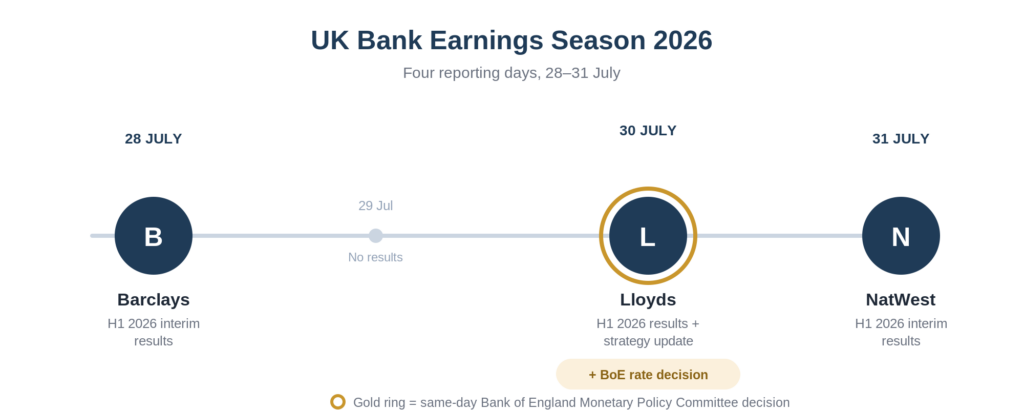
- Barclays reports 28 July 2026, Lloyds reports 30 July 2026 (alongside a new strategy update), and NatWest reports 31 July 2026.
- Lloyds’ results land on the same day as a live Bank of England interest rate decision (30 July) — a genuine coincidence worth watching.
- All three banks beat expectations in Q1 2026, with rising net interest margins, strong capital ratios, and generous dividend/buyback plans.
- The UK consumer picture has weakened since Q1: unemployment is at 4.9% and consumer loan defaults have hit a 17-year high.
- A proposed windfall tax on bank reserves is a real, unresolved political risk that could affect 2026-27 profits.
- A Bank of England proposal to ease leverage-ratio rules could free up extra capital specifically at Lloyds and NatWest.
Key Terms, Defined
A few terms come up repeatedly in bank earnings coverage. Here’s what each one means in plain language:
- Net Interest Margin (NIM): the profit a bank makes on lending, expressed as a percentage — roughly, the gap between what it earns on loans and pays on deposits, relative to its assets.
- Net Interest Income (NII): the pound (or dollar) amount of that lending profit across the bank’s whole balance sheet — the single biggest driver of profit at all three banks.
- CET1 ratio (Common Equity Tier 1 ratio): a bank’s core capital cushion, measured against its risk-weighted loans — the main gauge of how much financial shock a bank could absorb.
- RoTE (Return on Tangible Equity): profit measured against shareholders’ tangible equity — the headline profitability yardstick, used most heavily at Barclays.
- Leverage ratio: a simpler capital measure (capital divided by total exposures, with no risk-weighting) that has become the binding capital constraint at some UK banks.
- Asset Quality Ratio (AQR): impairment charges as a share of average loans — the key signal of whether borrowers are falling behind on repayments.
When Do Lloyds, Barclays, and NatWest Report H1 2026 Results?
Quick answer: Barclays reports 28 July 2026, Lloyds reports 30 July 2026, and NatWest reports 31 July 2026. In full:
- Barclays — Tuesday 28 July 2026: H1 2026 interim results.
- Lloyds Banking Group — Thursday 30 July 2026, 9:30am: H1 2026 results plus a new strategy update, the same day as the Bank of England’s next rate decision.
- NatWest Group — Friday 31 July 2026, 7:00am: H1 2026 results, followed by a 9:00am management presentation.
More detail on each below:
Barclays — 28 July 2026
Barclays kicks off the season with its H1 2026 interim results on 28 July 2026.
Lloyds — 30 July 2026 (and a Live Bank of England Decision the Same Day)
Lloyds reports its H1 2026 results on Thursday 30 July at 9:30am, presented by CEO Charlie Nunn and CFO William Chalmers, alongside a new strategy update. Notably, this is the same day the Bank of England’s Monetary Policy Committee announces its next rate decision — meaning Lloyds’ results and a live interest-rate call will land within hours of each other, which could add extra volatility to the stock that day.
NatWest — 31 July 2026
NatWest closes out the week with H1 2026 results released at 7:00am on Friday 31 July, followed by a 9:00am management presentation and a 1:00pm fixed income presentation.
Why This Earnings Season Matters
2025 and early 2026 were exceptionally profitable years for UK banks, driven by elevated Bank of England interest rates, strong lending margins, low unemployment, and limited loan losses. Every one of the three banks beat first-quarter expectations in 2026 and raised full-year guidance. Lloyds’ underlying profit rose 37% year-on-year. Barclays posted a group Return on Tangible Equity (RoTE) of 13.5%, above its own 12% target, and crossed £4 billion of quarterly investment banking income for the first time. NatWest grew total income 9.5% year-on-year and raised its full-year income guidance to the top of its previous range.
But the environment has shifted in ways that change the story for H1. Since the first-quarter results, UK unemployment has climbed to 4.9%, up from 4.6% a year earlier, and a widely tracked gauge of consumer loan defaults reached its highest level since 2009 in early July 2026. A proposed windfall tax on bank reserves has also resurfaced as a political risk, briefly wiping an estimated £6 billion off the combined market value of UK banks. In other words, the earlier assumption that a resilient UK consumer would simply keep supporting bank profits no longer holds as cleanly as it did a few months ago.
The Big Macro Themes to Watch
Interest Rates and Net Interest Income
A bank’s core business is borrowing money cheaply (from depositors) and lending it out more expensively (mortgages, business loans, credit cards). The gap between those two rates, multiplied across the bank’s entire loan book, is called net interest income (NII) — and it’s the single biggest driver of profit at all three banks. According to the Bank of England, the Bank Rate currently sits at 3.75%, held for a fourth consecutive meeting as of 18 June 2026, with the next decision due 30 July 2026 (the same day as Lloyds’ results). UK inflation was 2.8% in the year to May 2026, still above the Bank’s 2% target, which is one reason analysts are split on where rates go next: 2026 year-end forecasts range from as low as 3.5% to as high as 4.25%. The pace of any future rate cuts, and how much of that pressure banks can offset through loan growth, will likely be the most market-moving message from every earnings call this season.
The UK Mortgage Market’s Uneven Recovery
The UK housing market has not delivered a clean recovery story in 2026. House prices were up just 1.4% year-on-year as of June 2026, with a clear regional divide: prices fell in London while the North East, Northern Ireland, and North West saw the fastest growth. Mortgage approvals have been similarly choppy — April 2026 approvals hit a 15-month high, but May 2026 approvals then fell 11% year-on-year and 15% versus April, to 56,205. This uneven pattern matters most for Lloyds, the UK’s largest mortgage lender.
Consumer Credit: Rising Unemployment and Defaults
This is the theme that has changed the most since the spring. According to the Office for National Statistics (ONS), UK unemployment rose to 4.9% in the three months to April 2026 (from 4.6% a year earlier), with youth unemployment climbing to 16.2% from 14.3%. Separately, Bloomberg reported that a widely followed measure of consumer loan defaults — covering credit cards and other unsecured lending — hit its highest level since 2009 in early July 2026, with lenders reporting rising default rates by a net 34 percentage points. For a beginner investor, the takeaway is simple: watch each bank’s impairment charge (the amount set aside for loans that may not be repaid) closely this earnings season, particularly in credit cards and unsecured lending, rather than assuming the UK consumer is uniformly healthy.
Capital Returns: Dividends and Buybacks
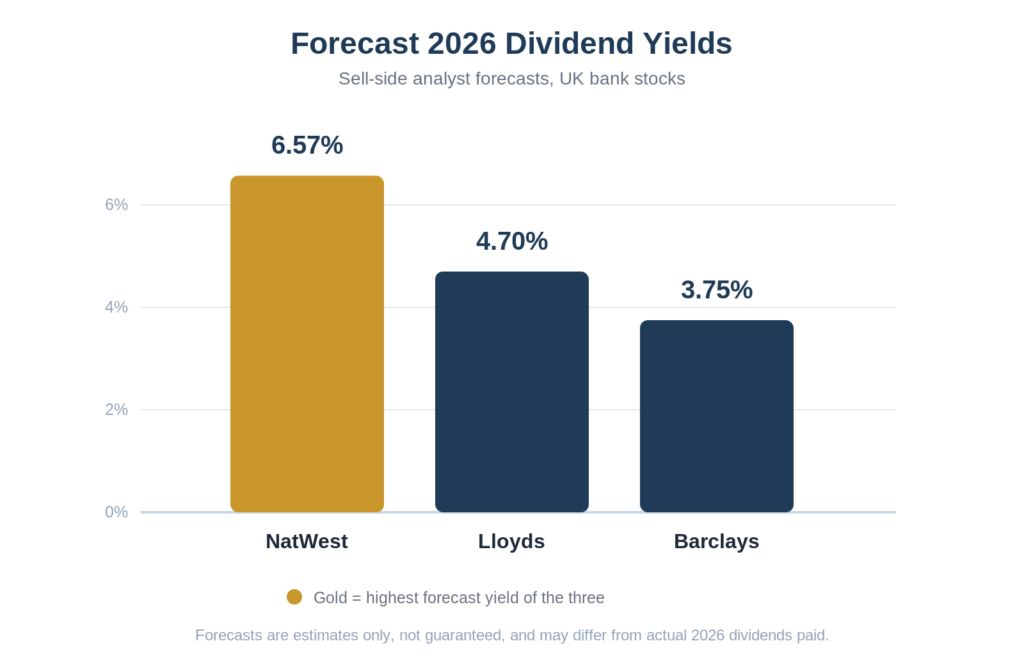
UK bank investors increasingly buy these stocks for income. Forecast 2026 dividend yields currently sit around 6.6% for NatWest, 4.7% for Lloyds, and 3.75% for Barclays, though Barclays leans more heavily on share buybacks than dividends as its preferred method of returning cash. All three banks have generated strong capital in 2026 and are expected to maintain generous shareholder returns provided capital ratios stay strong and credit quality doesn’t deteriorate.
Lloyds Banking Group: What to Watch
Lloyds is effectively a pure play on the UK domestic economy, with minimal exposure to global investment banking. Its results depend heavily on mortgages, retail deposits, UK consumers, and SME lending.
Net Interest Margin and Mortgage Lending
Lloyds’ net interest margin rose to 3.17% in Q1 2026, up 14 basis points year-on-year and 7 basis points quarter-on-quarter, prompting management to raise full-year net interest income guidance to above £14.9 billion. As the UK’s largest mortgage lender, watch for commentary on mortgage market share, new lending volumes, and pricing discipline given the choppy approvals data described above.
Credit Quality
Lloyds’ Q1 2026 underlying impairment charge was £295 million, an asset quality ratio of 25 basis points (or just 16 basis points excluding a £151 million charge tied to updated economic scenarios linked to Middle East tensions). Given the deteriorating consumer credit backdrop, H1 impairments are one of the most important numbers to watch — a meaningful increase would suggest the softer economic data is starting to show up in the loan book.
Capital Returns and the BoE Capital Rule Boost
Lloyds’ CET1 capital ratio stood at 13.4% at the end of Q1 2026, and management has guided to pay this down to around 13.0% by the end of 2026, with the board considering additional capital distributions twice yearly from mid-2026. Lloyds is also one of the banks named by the Bank of England as benefiting from proposed leverage-ratio easing (more on this below), which could free up further capital capacity.
Barclays: What to Watch
Barclays is structurally different from its two domestic-focused peers, combining UK retail and corporate banking with a genuinely global investment banking and markets business. This makes its results more complex, and more sensitive to global capital markets activity, than Lloyds’ or NatWest’s.
Investment Banking Momentum
Barclays’ investment bank surpassed £4 billion in quarterly income for the first time in Q1 2026, with investment banking income up 4% year-on-year and markets income up 13% (equities up 23%, fixed income and currencies up 8%). Watch management commentary on the IPO pipeline, M&A activity, and corporate confidence, which will shape sentiment on whether this momentum can continue into H1.
UK Retail Bank Performance
Barclays UK delivered a 19.7% RoTE on £2.3 billion of income in Q1 2026, with UK lending up 5% year-on-year, including £1.7 billion of mortgage growth and the addition of the Tesco Bank card portfolio. Watch for continued mortgage growth and deposit trends here.
Return on Tangible Equity (RoTE)
Barclays’ group RoTE reached 13.5% in Q1 2026, above its own greater-than-12% target for the year. This is the single metric analysts watch most closely at Barclays, since a higher RoTE generally supports further buybacks, dividend growth, and a higher valuation. Barclays’ CET1 ratio was 14.1% (13.9% rebased for its £500 million Q1 buyback), and management has targeted more than £15 billion of cumulative capital return between 2026 and 2028, alongside a planned £2 billion dividend for 2026.
NatWest: What to Watch
NatWest has been one of Europe’s strongest-performing bank stocks over the past two years and reports H1 2026 results on 31 July.
Net Interest Income and Margin
NatWest’s net interest income grew 12% year-on-year to £3.39 billion in Q1 2026, with net interest margin improving to 2.47%. Total income reached £4.4 billion (up 9.5% year-on-year) and full-year income guidance has been raised to the top of the bank’s previous £17.2-17.6 billion range. Watch whether this momentum, driven by mortgage and commercial lending growth of £7.2 billion and deposit growth of £3.1 billion in Q1, carries through to H1.
Commercial Banking and Government Stake Sale
NatWest has meaningful exposure to SMEs, commercial lending, and business deposits, making it a useful barometer of UK business confidence. Separately, the UK government’s residual stake in NatWest has fallen below 7%, with a sale of the remaining stake anticipated around mid-2026 — a long-standing overhang that is now close to fully resolved. NatWest’s CET1 ratio stood at 14.3% at the end of Q1 2026, with a liquidity coverage ratio of 144%, among the strongest capital positions of the three banks.
The Windfall Tax Risk, Explained
One of the more significant developments this year has been the resurfacing of a proposed windfall tax on UK banks. The Institute for Public Policy Research (IPPR) has floated a “QE reserves income levy” — sometimes described as a “Thatcher-style” bank tax, echoing a similar deposit levy introduced in 1981 — aimed at recouping profits UK banks have earned from interest paid on reserves held at the Bank of England during quantitative easing. Estimates of the potential impact vary widely: some put the levy at £7-8 billion annually across the Big Four banks (Barclays, Lloyds, HSBC, and NatWest), equivalent to roughly 18-20% of their combined 2026-27 expected pretax profit over two years, while other Treasury-linked estimates suggest a smaller £2-3 billion annual figure.
As of this writing, the UK Treasury has neither confirmed nor ruled out the policy, and any decision is expected to be addressed at the Autumn Budget. Even the possibility of the tax has been enough to move markets: shares in NatWest, Lloyds, and Barclays fell roughly 3-5% on a single day when the proposal resurfaced, wiping out an estimated £6 billion in combined market value. For investors, this is worth watching closely on each earnings call — any management commentary on the topic could move the stocks regardless of the quality of the underlying results.
The Bank of England’s Proposed Capital Rule Changes
On the more positive side, the Bank of England proposed a package of reforms to the UK bank capital framework in early July 2026, aimed at simplifying the regime and aligning it more closely with international standards. The key change is to the leverage ratio — a simpler capital measure (capital divided by total exposures, without risk-weighting) that has become the binding constraint for three of the UK’s seven major banks. The proposed reforms would cut the minimum leverage ratio from 3.25% to 3%, remove the countercyclical leverage buffer, and make part of the remaining buffer “releasable” during a downturn, reducing aggregate capital requirements by an estimated 20 basis points.
The Bank of England specifically named Lloyds, NatWest, Nationwide, and Santander UK as the domestically-focused lenders most likely to benefit, since the leverage ratio (rather than risk-weighted capital rules) has been their binding constraint. Sector-wide, this could free up capital capacity worth an estimated £150 billion in gilt-market-relevant balance sheet capacity. For Lloyds and NatWest shareholders in particular, this is a genuine, bank-specific tailwind worth watching for in management commentary during H1 results.
Comparing the Three Banks: Q1 2026 Snapshot
Here’s how the three banks compared heading into H1 2026, based on their most recent (Q1 2026) results:
| Metric (Q1 2026) | Lloyds | Barclays | NatWest |
|---|---|---|---|
| Net interest margin | 3.17% | n/a (segment-specific) | 2.47% |
| CET1 ratio | 13.4% | 14.1% (13.9% rebased) | 14.3% |
| Profitability | Profit +37% YoY | Group RoTE 13.5%; UK RoTE 19.7% | EPS 17.9p, +15.5% |
| Income/profit growth | Profit +37% YoY | Income £8.2bn, +6% YoY | Income £4.4bn, +9.5% YoY |
| Capital return signal | Path to ~13% CET1 by YE26 | £500m Q1 buyback; >£15bn 2026-28 target | Government stake sale expected mid-2026 |
And here’s the macro backdrop each bank is reporting into:
| Macro indicator | Latest reading |
|---|---|
| Bank of England Bank Rate | 3.75% (held since Q2 2026) |
| UK CPI inflation | 2.8% (May 2026) |
| UK unemployment rate | 4.9% (Feb-Apr 2026) |
| UK house price growth (YoY) | 1.4% (June 2026) |
| Mortgage approvals (May 2026) | 56,205, down 11% YoY |
Risks and Considerations
The bull case for UK banks rests on net interest income proving more durable than expected as rate cuts remain slow and shallow, continued strong capital returns, a capital boost from the Bank of England’s proposed leverage-rule changes at Lloyds and NatWest, and continued investment banking momentum at Barclays. The bear case centers on rising unemployment and consumer loan defaults at a 17-year high, an uneven mortgage recovery, the unresolved windfall tax risk, and the reality that today’s elevated net interest margins will eventually compress as the Bank of England does cut rates — the only real question is how quickly. None of this is a prediction of what will happen; it’s simply the set of forces likely to shape how each bank’s H1 2026 results are received.
Frequently Asked Questions
When do Lloyds, Barclays, and NatWest report H1 2026 results?
Barclays reports 28 July 2026, Lloyds reports 30 July 2026 (alongside a strategy update), and NatWest reports 31 July 2026.
Why does the Bank of England’s interest rate decision matter so much to these stocks?
Because net interest income, the core profit driver for all three banks, depends directly on the spread between loan and deposit rates, which moves closely with the Bank of England’s Bank Rate.
Is the UK windfall tax on banks actually going to happen?
As of this writing, no policy has been confirmed. It has been proposed by the IPPR and reportedly discussed within government, but the Treasury has neither confirmed nor ruled it out; a decision is expected around the Autumn Budget.
Which bank is most exposed to UK mortgages?
Lloyds, as the UK’s largest mortgage lender, with minimal exposure to global investment banking.
Which bank is least like a “pure” UK domestic bank?
Barclays, due to its sizeable global markets and investment banking division alongside its UK retail and corporate business.
Is the UK consumer still healthy?
Less clearly so than earlier in 2026. Unemployment has risen to 4.9% and a widely tracked consumer loan default gauge hit its highest level since 2009 in early July 2026 — a genuine deterioration worth watching for in H1 results.
Related Reading
BP vs. Shell: Which Oil Major Has the Better Dividend Right Now?
Key Takeaway
The 2026 UK bank earnings season is likely to be less about headline profit growth, which has already been strong, and more about durability: can Lloyds, Barclays, and NatWest sustain healthy net interest income and capital returns as UK unemployment rises and consumer credit shows real signs of strain? Guidance on net interest income, impairments, capital returns, and the windfall tax will likely matter more to share prices than the reported profit figures themselves.
Next Steps for the Reader
If you want to follow these results as they happen, mark 28, 30, and 31 July 2026 in your calendar, and pay particular attention to impairment charges and any management commentary on the windfall tax proposal. If you’d like to track share price moves in real time around each earnings date, a charting platform like TradingView can be a useful way to watch how the market reacts as each bank reports. As always, this article is for educational purposes and is not personalized financial advice — consider your own circumstances, or speak with a financial adviser, before making investment decisions.
Sources
- Lloyds Banking Group Financial Calendar
- Barclays Financial Calendar
- NatWest Group Results Centre
- Bank of England: Interest rates and Bank Rate
- ONS: Unemployment rate time series
- Bloomberg: UK Consumer Loan Default Gauge Jumps to Highest Since 2009
- Bank of England: Financial Stability in Focus — the bank capital framework
- AJ Bell: UK banking stocks fall on fears of windfall tax
Disclosure: The content on this page was produced with AI writing assistance under the editorial direction of a licensed Electrical Engineering practitioner and certified investor in different markets with over a decade of experience. All articles are reviewed and approved by the author before publication.
