
If you’ve watched Nvidia, AMD, and Broadcom trade in 2026, you’ve probably noticed something strange: they haven’t been moving together. Nvidia — still the largest AI company on the planet by market value — has lagged. AMD has ripped higher, gaining well over 180% in a single quarter. Broadcom has surged on blowout AI chip revenue, then dropped 14% in a day on a software miss. If you’re trying to figure out what’s happening to “AI stocks,” the headlines can feel contradictory.
Here’s the short version: this isn’t investors giving up on artificial intelligence. It’s AI stock rotation — capital moving between the companies that power the AI buildout, not out of the sector altogether. Understanding why that rotation is happening, and how Nvidia, AMD, and Broadcom each fit into it, is essential if you want to make sense of where the smart money is heading next.
What Is AI Stock Rotation? AI stock rotation is when investors shift capital between different companies within the AI sector — for example, from Nvidia into AMD or Broadcom — rather than exiting AI investments altogether. It typically happens as an investment theme matures and the market starts differentiating between AI winners based on growth, valuation, and business model rather than treating the whole sector as a single trade.
Key Takeaways
- AI stock rotation means investors are reallocating capital within the AI semiconductor sector, not exiting it — hyperscaler capital spending is still guided to rise roughly 77% in 2026 to about $725 billion combined.
- Nvidia remains the dominant AI training chip supplier by far, but its forward P/E (~24x) has compressed to a multiyear low even as revenue keeps hitting records.
- AMD has landed marquee multi-gigawatt supply deals with OpenAI and Meta, but its forward P/E (~81x) prices in aggressive future growth that hasn’t fully shown up yet.
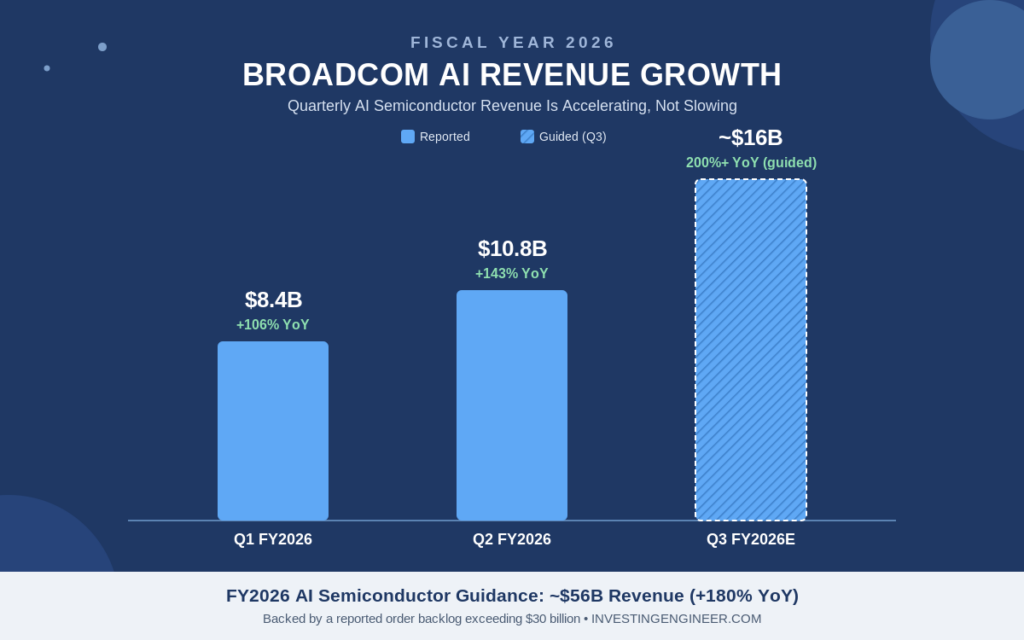
- Broadcom’s custom AI chip (XPU) business is growing the fastest of the three on a percentage basis, with AI semiconductor revenue growth accelerating from 106% to 143% to a guided 200%+ year-over-year.
- All three companies share a common risk: customer concentration and “circular financing” arrangements among OpenAI, hyperscalers, and chip suppliers.
Nvidia vs. AMD vs. Broadcom at a Glance
| Metric | Nvidia | AMD | Broadcom |
|---|---|---|---|
| Latest annual/guided AI revenue | $193.7B (FY2026 data center) | ~$15B (2026E data-center GPU) | ~$56B (FY2026E AI semiconductors) |
| Recent AI revenue growth (YoY) | Data center networking +142% | Data-center GPU +114% (2026E) | +106% → +143% → 200%+ guided |
| Forward P/E | ~24x | ~81x | ~33x |
| Trailing P/E | ~32x | ~185x | ~67x |
| Gross margin | ~71% | Not fully disclosed | ~68% |
| Free cash flow | ~$96.7B (~45% margin) | Not fully disclosed | ~$26.9B (~42% margin) |
| Market position | AI training leader | Challenger / second source | Custom silicon + infrastructure |
AMD’s specific gross margin and free cash flow figures were not consistently reported across sources at the time of writing and should be verified directly against AMD’s most recent quarterly filing.
Watch These Valuation Gaps Close (or Widen) in Real Time
Forward P/E ratios shift every time one of these three companies reports. Instead of relying on a snapshot, pull up NVDA, AMD, and AVGO side by side on a live chart and set alerts around their next earnings dates.
Compare Nvidia, AMD & Broadcom on TradingView →What Is “AI Stock Rotation” — and Is the AI Trade Really Over?
In investing, rotation simply means money moving from one stock, sector, or theme to another. It doesn’t necessarily mean investors are leaving the market — it means they’re changing where within a theme they want exposure.
Early in the AI buildout, there was really only one way to play it: Nvidia. The company’s GPUs were, for years, the only credible way to train large AI models at scale, and its stock captured nearly all of the sector’s upside. But by 2026, that’s no longer true. AMD has become a legitimate second source for AI accelerators. Broadcom has built a multibillion-dollar business designing custom AI chips for hyperscalers like Google and Meta. Memory makers like Micron are riding the same wave from a different angle.
Why Rotation Is Happening Now
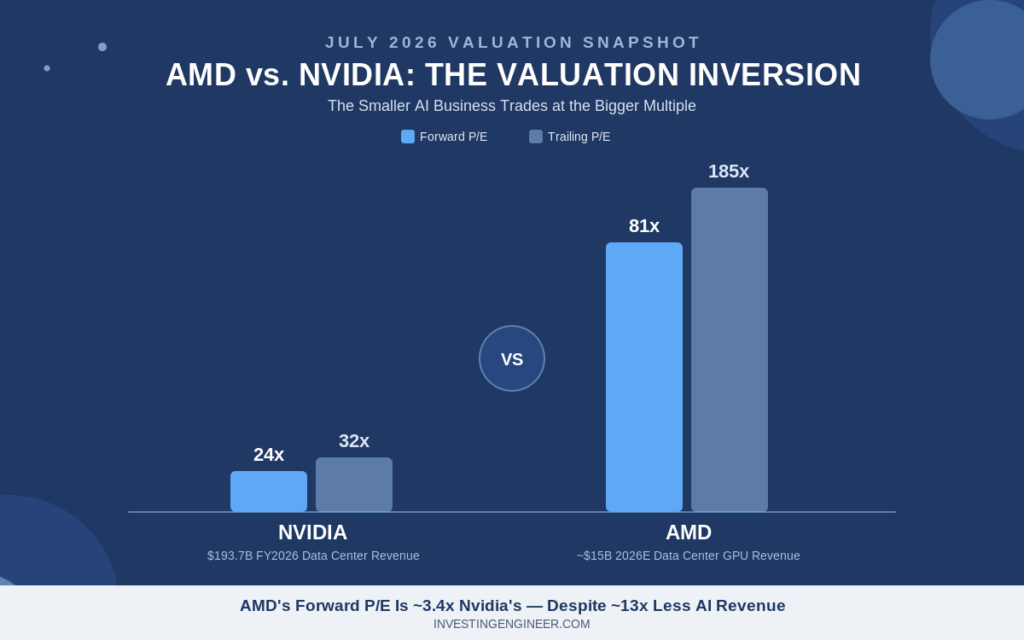
A few forces are driving the shift. First, simple profit-taking: after years of outsized gains, some investors are trimming Nvidia to lock in returns. Second, valuation math has changed — Nvidia’s forward P/E has actually fallen to around 24x even as its revenue keeps growing, while AMD’s forward multiple has climbed to roughly 81x on the promise of future share gains. That’s a real inversion of what many investors are used to, where the “expensive” stock and the “cheap” stock have effectively swapped places. Third, hyperscalers themselves are diversifying their chip suppliers on purpose, to avoid being dependent on a single vendor and to control costs — which mechanically spreads capital spending across more companies.
Rotating Within AI vs. Rotating Out of AI
It’s worth being precise here. None of the research behind this article points to hyperscalers actually cutting AI spending. Quite the opposite: Amazon, Alphabet, Meta, and Microsoft are collectively guiding to roughly $725 billion in 2026 capital expenditure, up about 77% from 2025’s already-record $410 billion. Microsoft alone has disclosed an $80 billion backlog of Azure capacity it can’t yet fulfill because of power constraints — that’s a company turning away demand, not a company worried about a slowdown. Rotation, in this case, is a sign of a maturing trade broadening out, not investors losing conviction in AI.
Nvidia: Can the Leader Stay on Top?
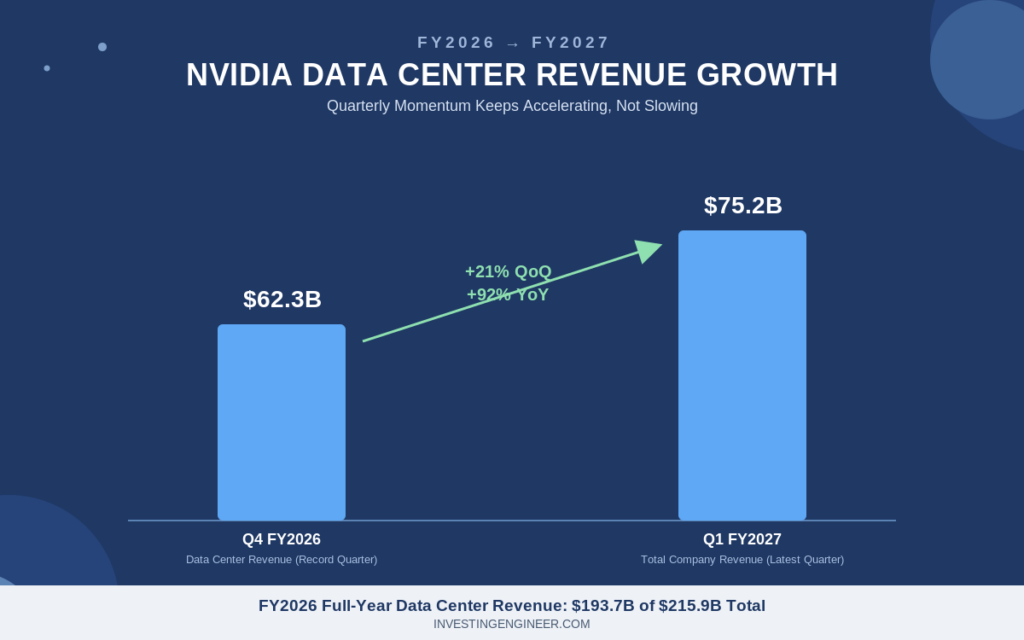
Nvidia remains the AI sector’s dominant force by almost any measure. In its fiscal year 2026 (ended January 2026), the company generated $215.9 billion in total revenue, with data center sales alone reaching $193.7 billion. Its most recent quarterly results (Q1 FY2027, reported around May 2026) showed revenue of $75.2 billion — up 92% year-over-year.
Blackwell, Rubin, and the Product Roadmap
Nvidia’s current-generation Blackwell chips have a reported backlog of 3.6 million units, and the newer GB300 variant now makes up roughly two-thirds of Blackwell revenue. The next architecture, Rubin, is planned for the second half of 2026 and is expected to deliver roughly five times the inference performance of Blackwell at a fraction of the cost per generated token — a potential re-acceleration catalyst if it ships on schedule. Rubin Ultra follows in 2027.
The CUDA Moat
One reason Nvidia has stayed on top for so long isn’t just hardware — it’s software. Nvidia’s CUDA platform has been the default programming environment for AI developers for well over a decade, and switching an entire codebase and team’s expertise to a different platform is genuinely expensive and time-consuming. That “moat” has been a key reason competitors have struggled to take meaningful share, even when their chips are competitively priced.
China Export Restrictions and Customer Concentration
Nvidia’s growth story isn’t without real headwinds. U.S. export licensing requirements on its H20 chips destined for China forced a $4.5 billion charge in the first quarter of fiscal 2026 alone, plus billions more in revenue the company simply couldn’t ship. Nvidia’s own management has said losing meaningful access to the China AI accelerator market — which it estimated could grow to nearly $50 billion — would be a material hit to the business. On top of that, a large share of Nvidia’s revenue comes from a relatively small number of hyperscaler and AI-lab customers, which is a risk worth watching regardless of how strong any single quarter looks.
AMD: The Challenger Closing the Gap
AMD is no longer just “the cheaper alternative to Nvidia.” In 2026, the company has landed some of the AI industry’s largest supply commitments. OpenAI has committed to a six-gigawatt, multi-generation buildout centered on AMD’s MI450 platform, with the first gigawatt scheduled to go live in 2026. Meta has committed to a five-year, $60 billion supply agreement built around an initial one-gigawatt MI450 deployment, and Oracle Cloud Infrastructure has signaled plans to deploy roughly 50,000 AMD AI chips.
MI400/MI450 and the Deals Behind the Rally
AMD’s MI400-series accelerators — including the MI450, paired with its “Helios” rack-scale platform — are set to launch in the second half of 2026, promising up to 40 petaflops of FP4 performance and a roughly 50% increase in memory bandwidth over the prior generation. Analysts estimate the MI400 series alone could generate about $7.2 billion in 2026 revenue, roughly a quarter of AMD’s data-center sales, with total data-center GPU revenue forecast to climb 114% year-over-year to around $15 billion.
EPYC’s Server Market Share Gains
It’s easy to focus only on AI accelerators, but AMD’s server CPU business, EPYC, has quietly become a genuine juggernaut. AMD captured a record 46.2% of x86 server CPU revenue share in the first quarter of 2026 — up from a much smaller share just a few years ago — continuing to take business from Intel, which still ships the majority of units but has been losing both unit and revenue share for multiple consecutive quarters.
Why AMD’s Valuation Is Controversial
Here’s the catch: AMD’s stock has run hard enough that it now trades at a forward P/E near 81x — one of the richest multiples in large-cap semiconductors, and dramatically higher than Nvidia’s roughly 24x. That doesn’t automatically make AMD a bad investment; it means the market has already priced in substantial future growth from the MI400 ramp and continued EPYC share gains. If AMD executes on schedule, that multiple could look reasonable in hindsight. If it stumbles, the stock has much further to fall than a company already priced for modest expectations.
See How the Leader-vs-Challenger Story Is Trading
Nvidia’s forward P/E and AMD’s forward P/E tell very different stories about how much future growth is already priced in. Chart both against each other on TradingView to see which narrative the market is leaning into this week.
Chart Nvidia vs. AMD on TradingView →Broadcom: The Quiet AI Infrastructure Winner
While Nvidia and AMD get most of the headlines, Broadcom has quietly built one of the fastest-growing AI businesses in the sector — just through a different model.
Custom AI ASICs (XPUs) Explained
Instead of selling general-purpose GPUs, Broadcom designs custom AI chips — called XPUs — tailored to the specific workloads of individual hyperscaler customers, reportedly including Google, Meta, OpenAI, and Anthropic. These application-specific chips can offer 30% to 50% lower total cost of ownership than GPU-based computing for the exact workload they’re built for, which is a major reason hyperscalers keep signing up. The results show up in the numbers: Broadcom’s AI semiconductor revenue grew 106% year-over-year in the first quarter of fiscal 2026, then accelerated to 143% in the second quarter, with management guiding for over 200% year-over-year growth in the third quarter. Full-year AI semiconductor revenue guidance sits at roughly $56 billion, backed by a reported order backlog exceeding $30 billion.
Networking, Software, and Diversified Exposure
Broadcom’s appeal isn’t limited to custom chips. It’s also a leader in the Ethernet switching and networking hardware that connects massive GPU and ASIC clusters together — meaning it benefits from AI infrastructure buildouts regardless of which chip vendor wins a specific contract. Combined with its enterprise software business (including VMware), Broadcom offers a more diversified profile than a pure-play chipmaker.
The June 2026 Software Miss — What It Revealed
That diversification is a double-edged sword. In June 2026, Broadcom’s stock fell as much as 14% in a single session after its software segment came in below expectations — even though AI semiconductor revenue beat forecasts. It’s a useful reminder that a diversified business can also be dragged down by a weak link, and that “diversified” doesn’t automatically mean “lower risk” in every scenario.
Financial Comparison: Nvidia vs. AMD vs. Broadcom
| Metric | Nvidia | AMD | Broadcom |
|---|---|---|---|
| Latest annual/guided AI revenue | $193.7B (FY2026 data center) | ~$15B (2026E data-center GPU) | ~$56B (FY2026E AI semiconductors) |
| Recent AI revenue growth (YoY) | Data center networking +142% | Data-center GPU +114% (2026E) | +106% → +143% → 200%+ guided |
| Gross margin | ~71% | Not fully disclosed | ~68% |
| Free cash flow | ~$96.7B (~45% margin) | Not fully disclosed | ~$26.9B (~42% margin) |
| Market position | AI training leader | Challenger / second source | Custom silicon + infrastructure |
AMD’s specific gross margin and free cash flow figures were not consistently reported across sources at the time of writing and should be verified directly against AMD’s most recent quarterly filing.
Valuation Comparison: Which Stock Is Actually Cheap?
| Metric | Nvidia | AMD | Broadcom |
|---|---|---|---|
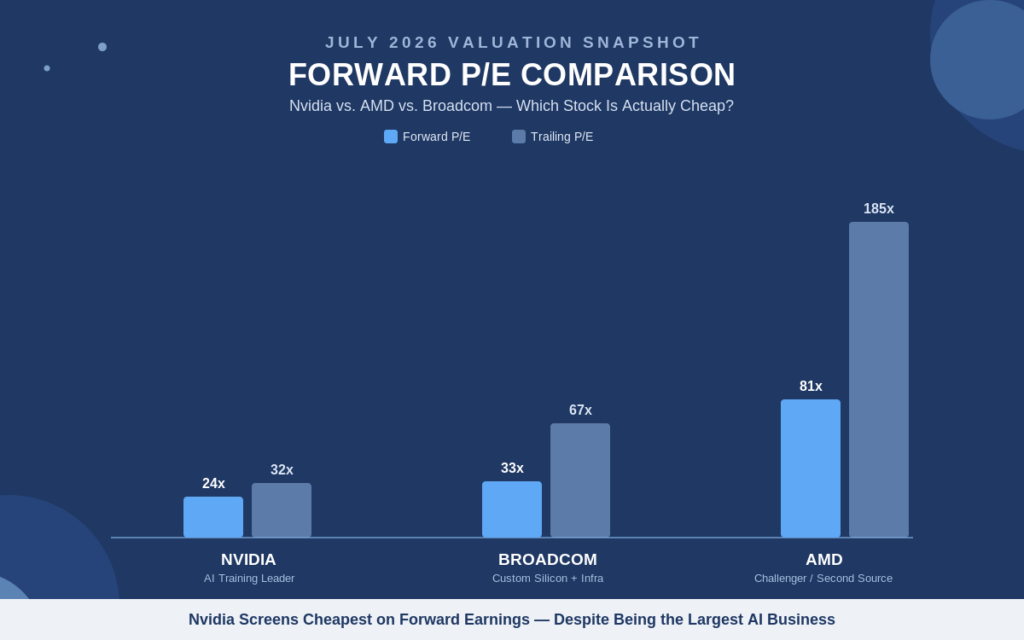
| Forward P/E | ~24x | ~81x | ~33x |
| Trailing P/E | ~32x | ~185x | ~67x |
On a forward-earnings basis, Nvidia currently screens as the cheapest of the three, despite being by far the largest AI business. AMD is the most expensive by a wide margin, reflecting how much future growth is already baked into the stock price. Broadcom sits in the middle — pricier than Nvidia, but far cheaper than AMD, with an accelerating AI revenue growth rate to help justify the premium.
AI Exposure and Business Model Resilience
Each company’s AI revenue comes from a different mix of workloads. Nvidia is most exposed to AI training — the computationally heavy process of building and refining large models — where its GPUs and CUDA ecosystem remain the default choice. AMD is pursuing both training and inference with its MI400 series, positioning itself as a credible alternative for hyperscalers that want a second supplier. Broadcom is most exposed to inference and infrastructure: its custom ASICs are typically built for a hyperscaler’s specific, high-volume inference workloads, and its networking business benefits no matter which chip architecture wins.
If AI spending were to slow broadly, the businesses with the most flexible, general-purpose exposure (Nvidia’s GPUs) and the most diversified revenue base (Broadcom’s networking and software) may prove more resilient than a business still ramping a narrower set of committed deals (AMD’s still-developing accelerator franchise) — though all three would likely feel some impact.
Customer Concentration and Circular Financing Risk
Here’s a risk that applies to all three stocks and doesn’t get enough attention: a growing web of “circular” financing arrangements among AI labs, hyperscalers, and chip suppliers. OpenAI, for example, closed a $122 billion funding round in which Amazon committed up to $50 billion and Nvidia committed $30 billion — while also expanding its AWS compute agreement by $100 billion. In arrangements like this, the same companies are simultaneously customers, suppliers, and investors in one another, which means trouble at one link in the chain can ripple through the others. OpenAI’s own CFO has publicly acknowledged that if the company’s revenue growth doesn’t accelerate as planned, it could struggle to pay for the computing capacity it has already committed to. That’s not a reason to panic, but it is a reason to understand that Nvidia, AMD, and Broadcom’s AI revenue is, to varying degrees, tied to the financial health of a relatively small and interconnected group of customers.
Risks to Watch for Each Company
Nvidia:
- Elevated absolute valuation even after multiple compression
- Continued exposure to U.S.-China export policy
- Rising competition from both AMD and hyperscalers’ own internal chip programs
- Customer concentration among a handful of AI labs and cloud providers
AMD:
- A forward P/E that leaves little room for execution missteps
- Still a distant second to Nvidia in AI training revenue
- Risk that headline multi-gigawatt deals take longer than expected to convert into actual shipped revenue
- ROCm software ecosystem still maturing relative to CUDA
Broadcom:
- Concentrated exposure to a small number of hyperscaler ASIC relationships
- Software segment (VMware) has already shown it can disappoint even when AI chip revenue beats
- Regulatory scrutiny around large tech consolidation
- Custom chip design wins can be lost to competitors like Marvell in future cycles
Catalysts for the Next 12 Months
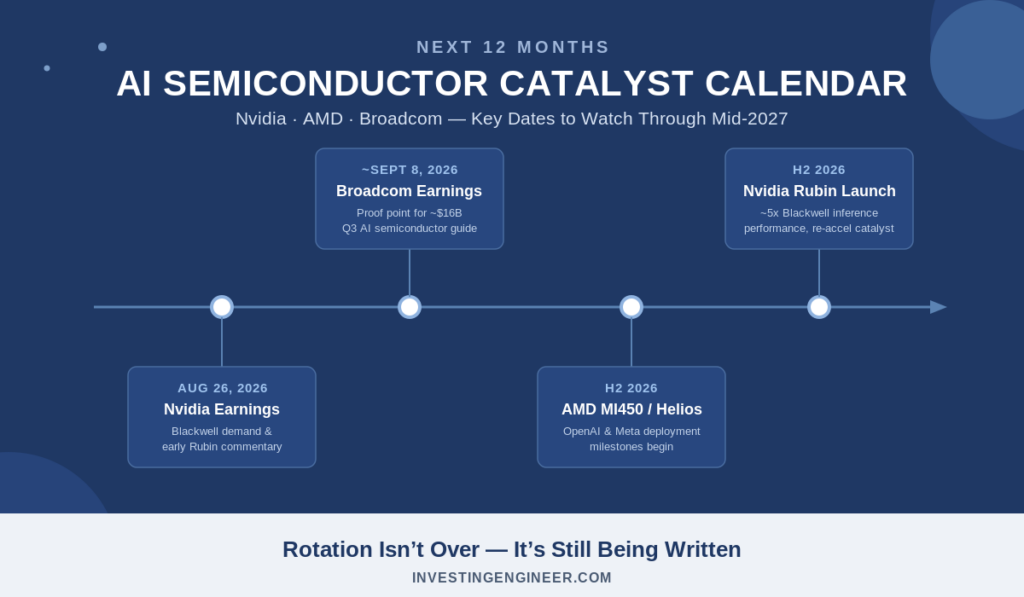
- August 26, 2026: Nvidia reports earnings after market close — the next major data point on Blackwell demand and early Rubin commentary.
- H2 2026: AMD’s MI450/Helios platform launch, along with early deployment milestones from the OpenAI and Meta agreements.
- H2 2026: Nvidia’s Rubin platform launch, positioned as a potential re-acceleration catalyst.
- ~September 8, 2026: Broadcom reports earnings, with management having already guided to roughly $16 billion in AI semiconductor revenue for the quarter — a key proof point for its $56 billion full-year target.
Earnings Days Move Fast — Here’s How to Follow Along
Nvidia reports August 26 and Broadcom reports around September 8 — two of the most closely watched prints in the entire AI trade. If you’re interested in how that kind of volatility plays out beyond the stock itself, Pepperstone lets you follow and trade related FX and index moves as they unfold. As with any trading decision, understand the risks before committing capital.
Explore Pepperstone →How to Think About Diversifying Across AI Chip Stocks
If the rotation described above has you wondering how to structure your own AI exposure, here’s a simple framework to work through:
- Identify what role each stock plays. Nvidia is the training leader, AMD is the emerging second-source challenger, and Broadcom is the diversified custom-silicon and networking play. Decide whether you want exposure to one role or several.
- Match valuation to conviction. A stock priced for near-flawless execution (like AMD’s ~81x forward P/E) requires higher conviction in its roadmap than a stock priced more conservatively (like Nvidia’s ~24x).
- Weigh concentration risk against diversification. A single-stock position is simpler but ties your returns to one company’s execution; splitting exposure across two or three names spreads company-specific risk while keeping you invested in the broader AI infrastructure theme.
- Watch the shared risk factors, not just the company-specific ones. Customer concentration and circular financing arrangements can affect all three stocks simultaneously, so diversifying across Nvidia, AMD, and Broadcom doesn’t fully diversify away sector-wide AI demand risk.
- Use upcoming catalysts as checkpoints. Earnings dates (Nvidia August 26, Broadcom ~September 8) and product launches (Rubin, MI450/Helios) are natural points to revisit position sizing rather than trying to time entries and exits day to day.
- Revisit the allocation as the rotation evolves. Sector rotations aren’t one-time events — capital could rotate back toward Nvidia, further toward AMD and Broadcom, or toward other AI infrastructure names like Micron, depending on how each company executes.
Build Your AI Chip Watchlist Before the Next Rotation
If you’re weighing how much of your AI exposure to put in Nvidia versus AMD versus Broadcom, start by watching all three move together. A free TradingView watchlist makes it easy to track price action, set earnings alerts, and see the next rotation as it starts.
Build an AI Chip Stock Watchlist on TradingView →Should You Own One, Two, or All Three?
This article isn’t personalized financial advice, and the right answer depends on your own risk tolerance, time horizon, and existing portfolio exposure — something worth discussing with a licensed financial advisor if you’re unsure. That said, the research here doesn’t point to a single “correct” winner. Nvidia, AMD, and Broadcom occupy genuinely different roles in the AI buildout: Nvidia as the training leader with a now-cheaper valuation, AMD as the high-growth challenger priced for near-flawless execution, and Broadcom as a diversified way to capture custom silicon and networking demand regardless of who wins any individual GPU contract. Many investors treat these as complementary rather than mutually exclusive exposures to the same broader trend, rather than trying to pick a single winner.
Frequently Asked Questions
Is the AI trade over?
No — hyperscaler capital spending is guided to rise roughly 77% in 2026 to about $725 billion combined. What’s changed is which companies are capturing the incremental spending, not whether the spending is happening.
Why did Nvidia underperform AMD and Broadcom in 2026 even with record revenue?
Nvidia’s dominance was already priced into the stock, so incremental investor enthusiasm shifted toward companies seen as having more room to re-rate (AMD) or offering more diversified AI exposure (Broadcom).
Is AMD’s rally justified?
It’s genuinely debated. Bulls point to signed multi-gigawatt deals with OpenAI and Meta as evidence the growth is real; bears note AMD’s forward P/E of roughly 81x already prices in substantial future share gains that haven’t fully materialized in trailing earnings yet.
What is Broadcom’s edge?
A diversified business spanning custom AI chips, networking hardware, and enterprise software, which gives it exposure to AI infrastructure spending broadly — though its software segment has also shown it can disappoint independently of AI chip strength.
Should I buy Nvidia, AMD, or Broadcom right now?
This article provides research and comparison, not individualized investment advice. Consider your own risk tolerance and consult a licensed financial advisor before making investment decisions.
Related Reading
Is the AI Chip Rally Over? What the July 2026 Selloff Really Showed
Understanding High-Bandwidth Memory (HBM) and the AI Chip Supply Chain
SK Hynix Earnings Preview: The HBM Story Heading Into July 29
Top 10 Undervalued Stocks to Buy in July 2026
Bottom Line
The 2026 AI stock rotation isn’t a story about investors losing faith in artificial intelligence — it’s a story about a trade that used to have one obvious winner now having three legitimate ones, each playing a different role. Nvidia still dominates AI training and has gotten meaningfully cheaper on a forward-earnings basis. AMD has proven it can win marquee customers but now has to deliver on a valuation that assumes it will. Broadcom has built a fast-growing, diversified infrastructure business that benefits from the AI buildout almost regardless of which GPU or ASIC architecture wins any single contract.
Next steps for the reader: Before making any moves, review each company's most recent quarterly filing directly, watch the upcoming Nvidia (August 26) and Broadcom (~September 8) earnings reports for confirmation of the trends described here, and consider how much of your portfolio's AI exposure is concentrated in a single company versus spread across the different roles Nvidia, AMD, and Broadcom each play in the buildout.
Don’t Just Read the Rotation — Watch It Happen
Nvidia, AMD, and Broadcom won’t stop moving once you finish this article. Track their charts, valuations, and earnings dates in one place, and if you’re interested in trading the volatility around the next print, you can do that too.
| Compare NVDA, AMD & AVGO on TradingView → |
| Trade Semiconductor Earnings Volatility with Pepperstone → |
This article is for informational and educational purposes only and does not constitute financial or investment advice. Always conduct your own research and consult a licensed financial advisor before making investment decisions.
Disclosure: The content on this page was produced with AI writing assistance under the editorial direction of a licensed Electrical Engineering practitioner and certified investor in different markets with over a decade of experience. All articles are reviewed and approved by the author before publication.
