
In this tutorial, I’ll teach you 7 important income statement ratios that you need to know when analyzing an income statement. These ratios are widely used by large institutional investors to small retail investors. Many businesses are now letting a specialized team handle management, from anything to marketing, sales to analytics. Companies that offer these services and more like Salesforce are a major part in today’s business dynamic.
I learned all of this stuff on the book by Mary Buffett and David Clark, Warren Buffett and the Interpretation of Financial Statements and I’m excited to share this knowledge to you.
At the end of this post, you’ll learn how to use and apply them in your stock valuations.
So let’s get started.
The 7 Income Statement Ratios And How To Use Them
From the Income Statement, we’ll derive each of the 7 important Income Statement ratios which are as follows;
- Gross Profit Margin
- Operating Profit Margin
- Net Profit Margin
- Selling, General & Administration to Gross Profit
- Depreciation to Gross Profit
- Research & Development to Gross Profit
- Interest Expense to Operating Profit
So first on the list, we have the Gross Profit Margin.
#1 Gross Profit Margin
Gross Profit is the money made by a company after all the costs of raw goods and materials are subtracted from the Revenue. If you divide it by the Revenue, we get the Gross Profit Margin; a ratio that tells us how much Gross Profit is made for every one peso of Revenue.
The formula for Gross Profit Margin is;
[thrive_text_block color=”light” headline=””]Gross Profit Margin % = (Gross Profit / Revenue) x 100[/thrive_text_block]
Where:
[thrive_text_block color=”light” headline=””]Gross Profit = Revenue – Cost Of Revenue[/thrive_text_block]
To illustrate, if a company’s Revenue is Php 100 and the Gross Profit is Php 50, we get a margin of 50% which means that the company made 50 centavos of Gross Profit for every 1 peso of Revenue.
Some Income Statements shows how much Gross Profit a company has made. Consider this example of Puregold’s (PGOLD) Income Statement below.
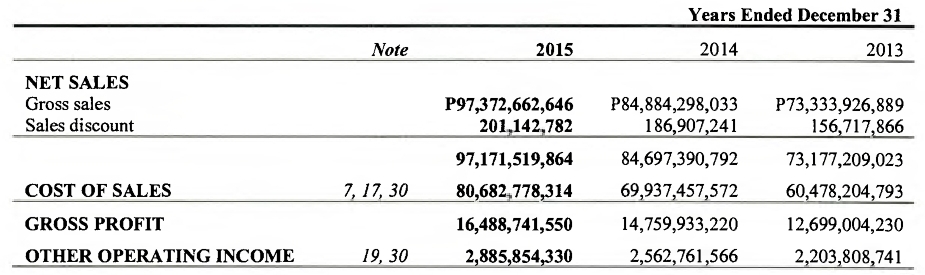
It’s clearly shown that the Gross Profit in 2015 is Php 16,488,741,550 while Revenue is Php 97,372,662,646. If you subtract the Sales Discount in the Revenue, you’ll get Net Revenue (Net Sales) which is Php 97,171,519,864.
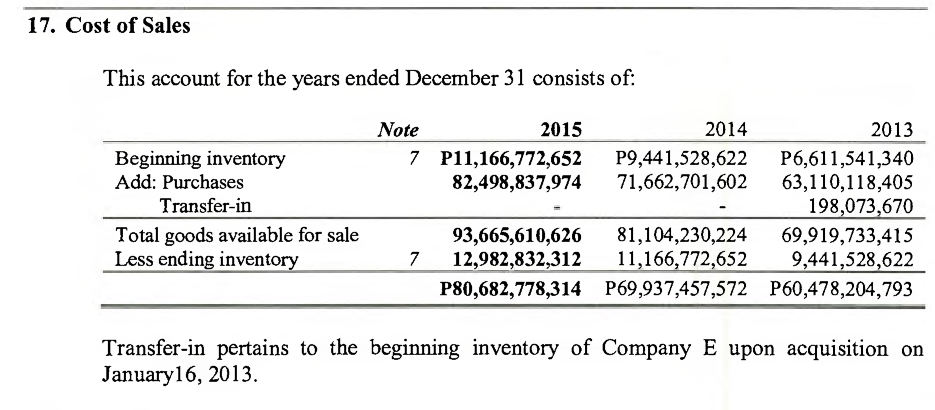
The Cost Of Revenue (Cost Of Sales) is also shown here as Php 80,682,778,314. If you want to determine the components of this item, you should proceed by looking at notes 7, 17 and 30 of the annual report. Note 17 explains what the figure is composed of as seen below.
[thrive_text_block color=”light” headline=””]TIP # 1: It’s very important to look at these notes so that you can verify the numbers presented in the Income Statement.[/thrive_text_block]
The Gross Profit Margin in this example is;
[thrive_text_block color=”light” headline=””]Gross Profit Margin % = (Php 16,488,741,550 / Php 97,171,519,864) x 100
Gross Profit Margin % = 16.97%[/thrive_text_block]
[thrive_text_block color=”light” headline=””]TIP # 2: You can do a slight variation in this example by using the Gross Sales instead of the Net Sales. By doing so, you’ll be able to calculate the real Gross Profit Margin without the effect of the Sales Discount entry.[/thrive_text_block]
Sometimes, there are times when the Gross Profit isn’t shown. If that’s the case, we have to calculate it manually. Consider Megaworld Corporation’s (MEG) Income Statement as an example.
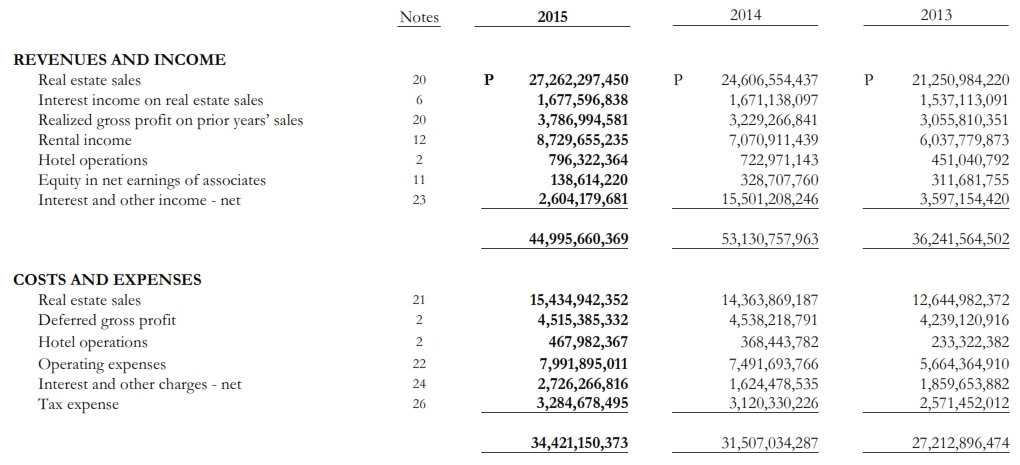
To calculate the Gross Profit, we need to identify the Total Revenue and exclude the Non-recurring/Non-operating Income and Interest Income. In the above example, we exclude the Equity In Net Earnings Of Associates and Interest And Other Income – Net. The rest when added, is the Total Revenue.
So let’s calculate the figures for the year 2015;
[thrive_text_block color=”light” headline=””]Total Revenue = Php 44,995,660,369 – Php 138,614,220 – Php 2,604,179,681
Total Revenue = Php 42,252,866,468[/thrive_text_block]
The second thing we need to do is to identify the items that can be included in the Cost Of Sales.
The Cost And Expenses lists items such as Real Estate Sales, Deferred Gross Profit and Hotel Operations which when added, is the total Cost Of Sales.
Let’s add the items;
[thrive_text_block color=”light” headline=””]Cost Of Sales = Php 15,434,942,352, + Php 4,515,385,332 + Php 467,982,367
Cost Of Sales = Php 20,418,310,051[/thrive_text_block]
[thrive_text_block color=”light” headline=””]TIP # 3: If you’re not sure that you’re doing the right thing, I suggest that you cross-reference your calculations on financial websites such as Wall Street Journal or Morning Star.[/thrive_text_block]
Now we can calculate the Gross Profit;
[thrive_text_block color=”light” headline=””]Gross Profit = Php 42,252,866,468 – Php 20,418,310,051
Gross Profit = Php 21,834,556,417[/thrive_text_block]
With these data, we now calculate the Gross Profit Margin;
[thrive_text_block color=”light” headline=””]Gross Profit Margin % = (Php 21,834,556,417 / Php 42,252,866,468) x 100
Gross Profit Margin % = 51.67%[/thrive_text_block]
[thrive_text_block color=”light” headline=””]Warren Buffett’s Rule: GPMs greater than 40% usually have some form of competitive advantage. GPMs with lower than 40% but greater than 20% are usually businesses in a highly competitive industry. GPMs lower than 20% are in a fierce competition.[/thrive_text_block]
In my case, a ratio of above 30% is good enough for me.
#2 Operating Profit Margin
Operating Profit is Gross Profit minus the Operating Expenses. If divided by the Revenue, we get the Operating Profit Margin which tells us how much Operating Profit is made for every one peso of Revenue.
Here’s the formula;
[thrive_text_block color=”light” headline=””]Operating Profit Margin % = (Operating Profit / Revenue) x 100[/thrive_text_block]
Where;
[thrive_text_block color=”light” headline=””]Operating Profit = Gross Profit – Operating Expenses[/thrive_text_block]
Consider PGOLD’s example below.
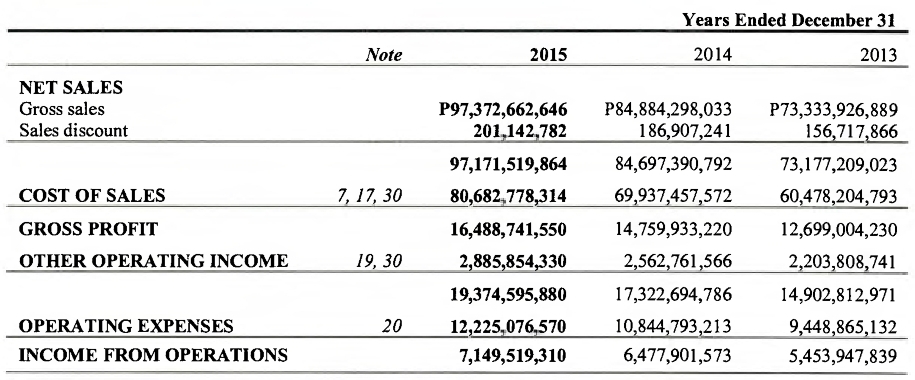
It is shown that the Operating Profit (Income From Operations) in 2015 is Php 7,149,519,310. To understand the figure better, we should determine the Operating Expenses that the company incurred.
Let’s look at Note 20.
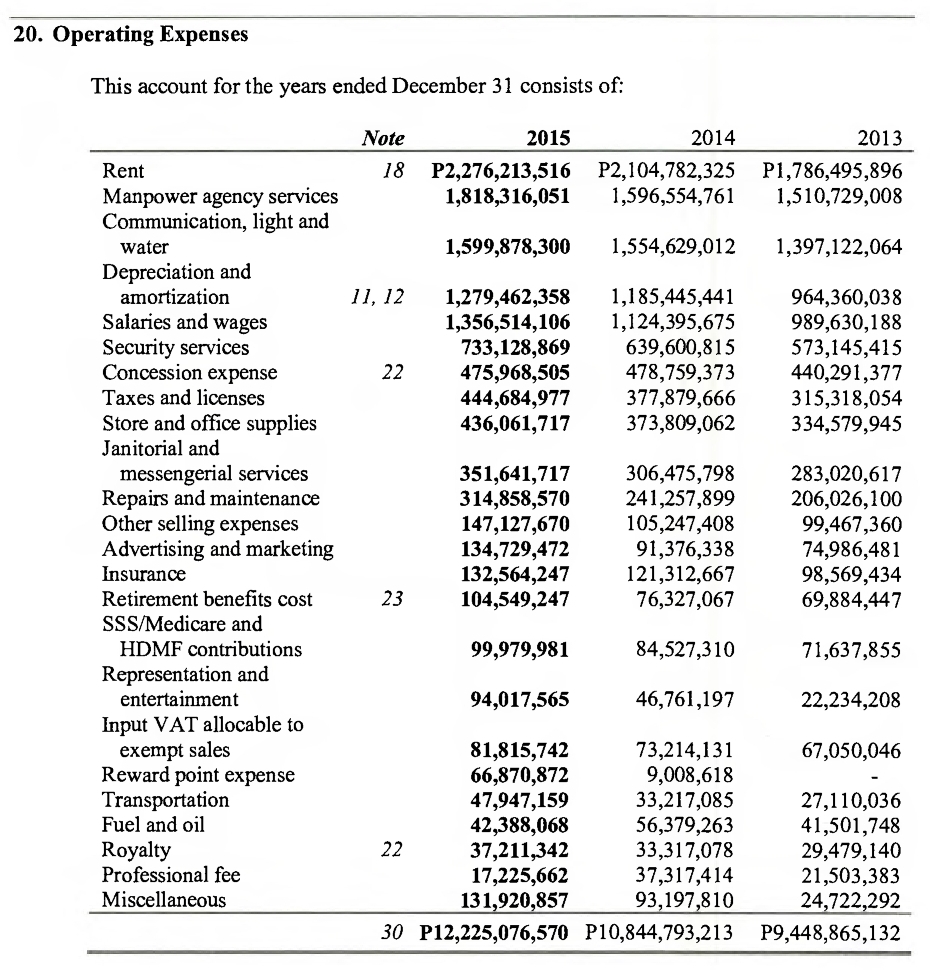
You can see from this section all the Operating Expenses the company made. By looking at the figures on each of the line items, you can see where the company spends the most.
In this example, it is evident that in 2015, PGOLD has spent a lot on Rent and Manpower Agency Services.
It is also shown that the company made money through other operations as listed in the entry Other Operating Income. Let’s see what kind of income is this on note 19.
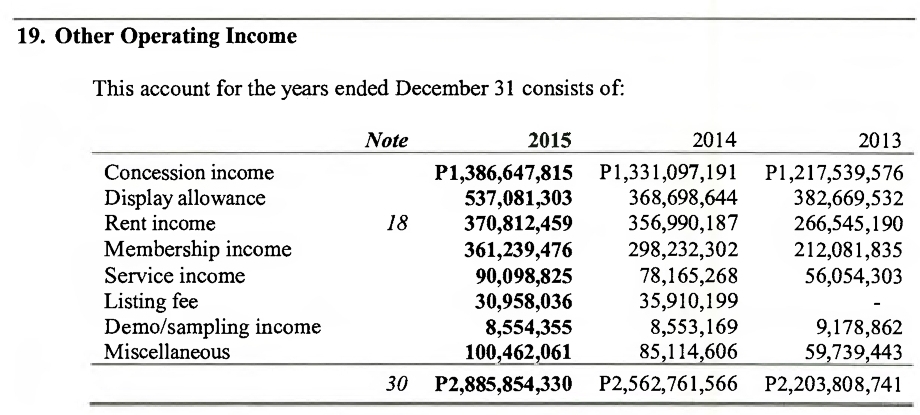
In this example, the company made most of its Other Operating Income through Concession Income.
The point of looking at these figures is to better understand the other income generation models the company is utilizing besides their main business model.
Okay, so let’s head on to the calculations. We have determined all of the variables and confirmed them by looking at the notes. We now apply the formulas;
[thrive_text_block color=”light” headline=””]Operating Profit = Gross Profit + Other Operating Income – Operating Expenses
Operating Profit = Php 16,488,741,550 + Php 2,885,854,330 – Php 12,225,076,570
Operating Profit = Php 7,149,519,310[/thrive_text_block]
The Operating Profit Margin would be;
[thrive_text_block color=”light” headline=””]Operating Profit Margin % = (Php 7,149,519,310 / Php 97,171,519,864) x 100
Operating Profit Margin % = 7.36%[/thrive_text_block]
Now if the Operating Profit is not listed as in the case of Fig. 3, then we should calculate it manually.
We had already calculated the Gross Profit to be Php 21,834,556,417. The Operating Expenses listed in the Income Statement amounts to Php 7,991,895,011.
Applying the formula for the Operating Profit;
[thrive_text_block color=”light” headline=””]Operating Profit = Php 21,834,556,417 – Php 7,991,895,011
Operating Profit = Php 13,842,661,406[/thrive_text_block]
Now for the Operating Profit Margin;
[thrive_text_block color=”light” headline=””]Operating Profit Margin % = (Php 13,842,661,406 / Php 42,252,866,468) x 100
Operating Profit Margin % = 32.76%[/thrive_text_block]
As a rule, OPMs equal to or above 20% are companies that do well. I’m more likely to be interested in stocks that meets this benchmark.
#3 Net Profit Margin
Net Profit Margin is a financial ratio that tells us how much income is made for every one peso of Revenue. This is also one of my favorite ratios because of its simplicity. By looking at this ratio, we can quickly tell how much the company earned within the year.
To illustrate, a company with a Net Profit Margin of 20% means that the company made 20 centavos of profit for every one peso of sales.
Here’s the formula.
[thrive_text_block color=”light” headline=””]Net Profit Margin % = (Net Income / Revenue) x 100[/thrive_text_block]
This is one of the most easiest and straightforward ratios that you can calculate because you would only need to look at the top and bottom figures of the Income Statement.
Let’s take a look again at PGOLD.
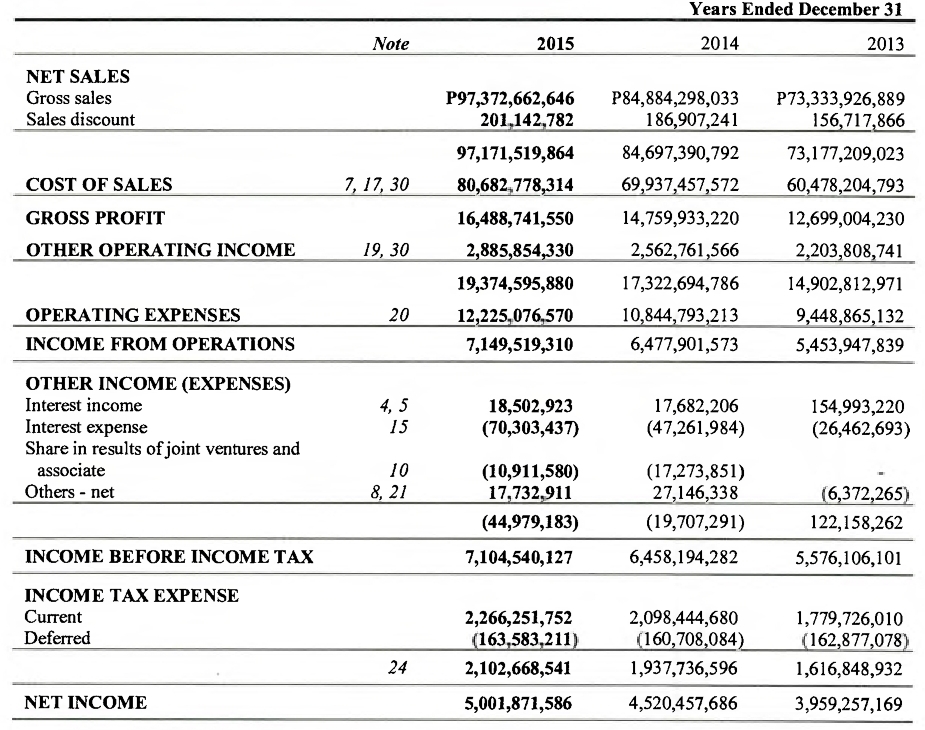
Net Profit Margin for 2015 is calculated as follows;
[thrive_text_block color=”light” headline=””]Net Profit Margin % = (Php 5,001,871,586 / Php 97,171519,864) x 100
Net Profit Margin % = 5.15%[/thrive_text_block]
This ratio means that the company made Php 0.0515 centavos for every one peso of Revenue.
[thrive_text_block color=”light” headline=””]Warren Buffett’s Rule: NPMs that are equal or greater than 20% usually have some form of long-term competitive advantage. NPMs greater or equal to 10% but less than 20% are usually highly competitive businesses. NPMs that are less than 10% are fiercely competitive industries.[/thrive_text_block]
As my personal rule, I look for businesses that has NPMs above 15%.
#4 Selling, General & Administration To Gross Profit
The formula for this ratio is shown below.
[thrive_text_block color=”light” headline=””]SG&A to GP % = (SG&A Expenses / Gross Profit) x 100[/thrive_text_block]
The importance of getting this ratio is to know how much SG&A Costs the company is spending relative to their Gross Profit. Normally, we want a business with low SG&A costs to maximize profits. That’s the purpose of this ratio.
The tricky part is looking for the SG&A Expenses because not all Income Statements display this figure.
Here’s a simple formula that you can use to calculate the SG&A Expenses.
[thrive_text_block color=”light” headline=””]SG&A Expenses = Operating Expenses – Depreciation & Amortization Costs – Research & Development Costs[/thrive_text_block]
To demonstrate the formula, refer back to Fig. 5. To get the SG&A Expenses for 2015, we need to exclude the Depreciation & Amortization Costs and Research & Development Costs.
In the example, we only need to remove the D&A Costs since the R&D Costs is not included.
Let’s now calculate the SG&A Expenses.
[thrive_text_block color=”light” headline=””]SG&A Expenses = Php 12,225,076,570 – Php 1,279,462,358 – 0
SG&A Expenses = Php 10,945,614,212[/thrive_text_block]
Now that we got the SG&A Expenses, we now calculate the SG&A to Gross Profit Margin.
[thrive_text_block color=”light” headline=””]SG&A to GP % = (Php 10,945,614,212 / Php 16,488,741,550) x 100
SG&A to GP % = 66.38%[/thrive_text_block]
Let’s take another example. We’ll again use MEG’s Income Statement. Let’s go back to Fig. 3.
There’s a line in there that says Operating Expenses. To see what it contains, we refer to Note 22. Let’s see what that section contains.
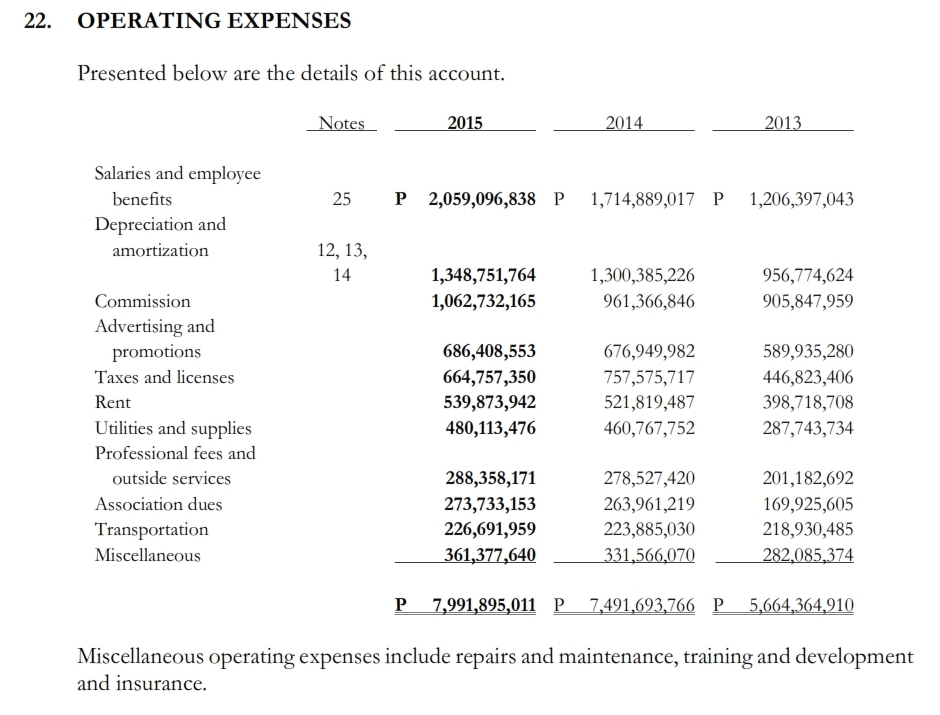
Just like the previous example, we need to separate the D&A and the R&D costs in the Operating Expenses.
Applying the formula;
[thrive_text_block color=”light” headline=””]SG&A Expenses = Php 7,991,895,011 – Php 1,348,751,764 – 0
SG&A Expenses = Php 6,643,143,247[/thrive_text_block]
For the SG&A to GP %;
[thrive_text_block color=”light” headline=””]SG&A to GP % = (Php 6,643,143,247 / Php 21,834,556,417) x 100
SG&A to GP % = 30.42%[/thrive_text_block]
[thrive_text_block color=”light” headline=””]Warren Buffett’s Rule: Companies that have consistent SG&A to GPs that are less than or equal to 30% are companies to consider.[/thrive_text_block]
I use the same ratio in determining my stock picks.
#5 Depreciation & Amortization To Gross Profit
Now why do we need to get the ratio between Depreciation & Amortization to Gross Profit? According to Warren Buffett, Depreciation is a real expense because any equipment will eventually wear out within its life span and be replaced. That’s the reason why we should learn to understand its effects on a company’s profitability.
Here’s the formula.
[thrive_text_block color=”light” headline=””]D&A to GP % = (Depreciation & Amortization / Gross Profit) x 100[/thrive_text_block]
Some Income Statements lists D&A Expenses like this one from Now Corporation (NOW).
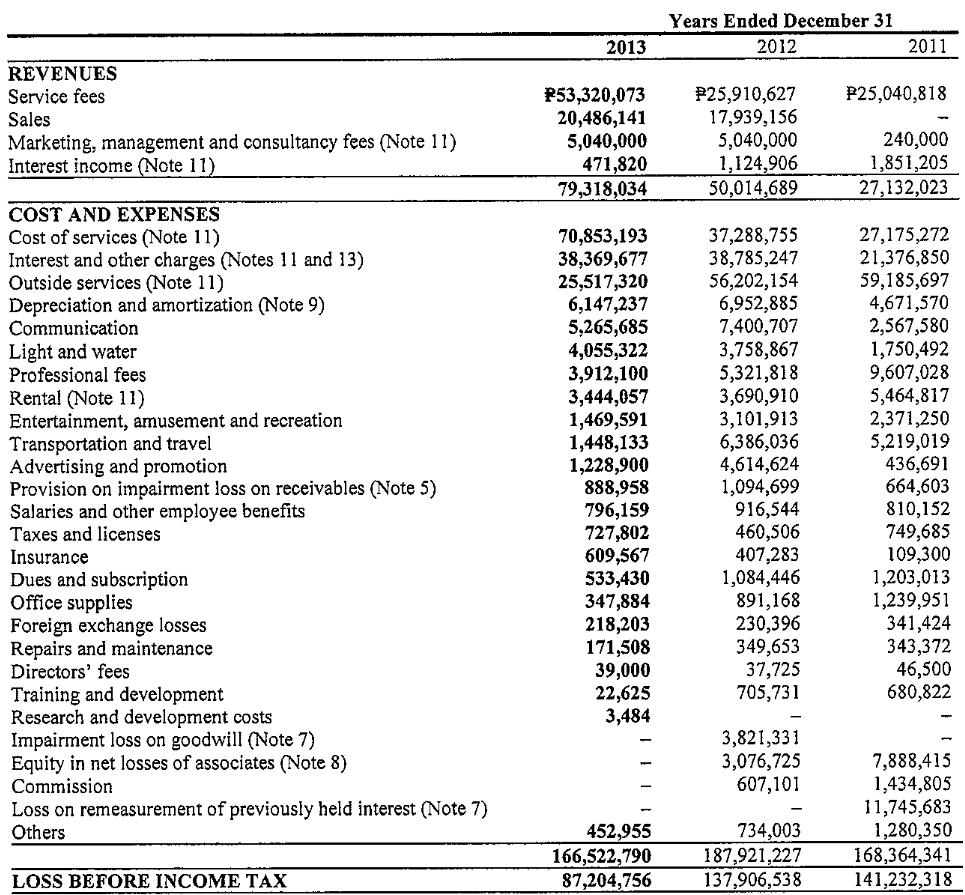
If this is the case, then you can calculate the D&A to GP by taking out the figures and applying the formula.
Here’s the calculation;
[thrive_text_block color=”light” headline=””]Revenue = Php 79,318,034 – Php 471,820
Revenue = Php 78,846,214
Cost Of Revenue = Php 70,853,193; (Cost Of Sales)
Gross Profit = Php 78,846,214 – Php 70,853,193
Gross Profit = Php 7,993,021
D&A to GP % = (Php 6,147,237 / Php 7,993,021) x 100
D&A to GP % = 76.90%[/thrive_text_block]
Most Income Statements don’t list D&A Expenses outright. To get this value, we need to calculate it.
Let’s again go back to Fig. 5.
As you noticed, there’s a line item in PGOLD’s Operating Expenses that says Depreciation & Amortization. That’s the number that we are looking at. We get that number and apply it to our formula.
[thrive_text_block color=”light” headline=””]D&A to GP % = (Php 1,279,462,358 / Php 16,488,741,550) x 100
D&A to GP % = 7.76%[/thrive_text_block]
[thrive_text_block color=”light” headline=””]TIP # 4: Sometimes, you can also find D&A costs included in the Cost Of Revenue. If you see that, you should add it. You can also use the Cash Flow Statement when looking for the D&A Costs. You can find it in the Cash Flow from Operating Activities section.[/thrive_text_block]
[thrive_text_block color=”light” headline=””]Warren Buffett’s Rule: The lower, the better.[/thrive_text_block]
As my rule, I look for D&A to GP ratios below 10%.
#6 Research & Development To Gross Profit
Warren Buffett mentions that the threat of a newer technology tends to put the long-term economics of a company at a risk. It’s for this reason that a company will spend high on R&D Expenses to maintain its competitive advantage. But if it fails, a company’s product or service may end up obsolete overnight. The importance of this ratio is to know exactly how much R&D Expenses is spent relative to Gross Profit.
The formula is this;
[thrive_text_block color=”light” headline=””]R&D to GP % = (Research & Development Costs / Gross Profit) x 100[/thrive_text_block]
Most companies do not have R&D Costs. But some, especially tech companies has this type of expense because these types of industries rely on updated technological advances.
Referring to Fig. 9, NOW’s R&D cost (R&D + Training & Dev’t) in 2013 amounts to Php 26,109.
Let’s calculate;
[thrive_text_block color=”light” headline=””]R&D to GP % = (Php 26,109 / Php 7,993,021) x 100
R&D to GP % = 0.33%[/thrive_text_block]
[thrive_text_block color=”light” headline=””]Warren Buffett’s Rule: The lower the ratio, the better.[/thrive_text_block]
In my case, I love it when it’s zero.
#7 Interest Expense To Operating Profit
Companies borrow money for a number of reasons. One reason is to fund capital expenditures. The other is when a company buys another company through a leveraged buyout.
The debt that the company carries on its books incurs interest which is then paid during the year. The logic is simple; more debt equals more interests to pay.
This ratio will tell us how much Interest a company pays in relation to its Operating Profits.
The formula for Interest Expense to Operating Profit is this;
[thrive_text_block color=”light” headline=””]IE to OI % = (Interest Expense / Operating Profit) x 100[/thrive_text_block]
To illustrate, let’s look at the previous example, Fig. 7.
You’ll notice that we can directly apply the formula. We’ll just pick up the figures for PGOLD’s Interest Expense in 2015 amounting to Php 70,303,437.
Let’s apply the formula.
[thrive_text_block color=”light” headline=””]IE to OI % = (Php 70,303,437 / Php 7,149,519,310) x 100
IE to OI % = 0.98%[/thrive_text_block]
[thrive_text_block color=”light” headline=””]TIP # 5: There are times when the Interest Expense and Interest Income is added up to get the Net Interest Expense/Income. If that happens, what I do is I break it down so that I get only the Interest Expense. You can find how it’s broken down by looking at the corresponding notes.[/thrive_text_block]
[thrive_text_block color=”light” headline=””]Warren Buffett’s Rule: IE to OI % equal to or less than 15% is good.[/thrive_text_block]
In my valuations, I look for a much lower ratio, like around 10%.
Final Thoughts
These 7 Income Statement ratios are very important in determining if a company has the ability to sustain its income for the long-term. I’ve discussed these ratios in simple detail to teach you exactly how you can calculate and interpret these numbers.
With that said, I encourage you to look at the Income Statements of your investments, practice calculating these ratios and try to understand and interpret them on your own.
For my next tutorial, I’ll discuss about how I use the P/E, P/BV and the Graham Ratio as popularized by Benjamin Graham in his book The Intelligent Investor in screening which stocks are worthy to dive into.
If you have any questions and clarifications in the materials I presented in this post, kindly leave your comment below. Let’s learn from each other.
Happy investing!
[divider style=’full’]
[thrive_text_block color=”light” headline=”FURTHER READING:“]
- Introduction: An Investor’s Guide To Understanding Financial Ratio Analysis
- 7 Important Income Statement Ratios And How To Use Them
- How To Use P/E and P/BV Ratio The Graham Way
- These 2 Powerful Balance Sheet Ratios Will Help You Determine A Company’s Financial Health
[/thrive_text_block]
Thank you Sir! Very helpful and it is presented very well. Keep it up! God bless!
You’re welcome Jefferson. 🙂
Great and informative article. Thank you for this bro. Keep it up. I’m learning from you.
You’re welcome bro. More to come! 🙂
GREAT READ! GOD BLESS YOU!