
This week’s top Asian stocks to watch are led by Taiwan Semiconductor (TSMC), Samsung Electronics, Alibaba, and Tencent, all reacting to major earnings or regulatory news. The big story: Japan’s AI-hardware stocks (SoftBank, Tokyo Electron, Advantest, Kioxia) are sliding after a sharp valuation reset, while Hong Kong-listed Chinese internet names are rallying after China approved Apple’s “Apple Intelligence” AI service.
Add in a softer-than-expected China GDP report, a steady uptrend in India, a range-bound Australia, and Alphabet and Tesla’s earnings on Wednesday, and you have a week where the same “AI theme” is producing opposite results depending on where a company sits in the AI supply chain.
Why This Week Matters
If you’ve been watching “AI stocks” as one big group, this week is a good reminder that they aren’t. Companies that make the chips and equipment behind AI (mostly in Japan and Taiwan) are having a rough stretch as investors worry about how much money is being spent on AI infrastructure versus how much profit it’s generating right now.
Meanwhile, companies that build AI products people actually use — like Alibaba’s cloud services or Tencent’s AI-powered apps — are being rewarded, especially after a fresh regulatory win in China. Understanding this split is the key to making sense of Asian markets this week.
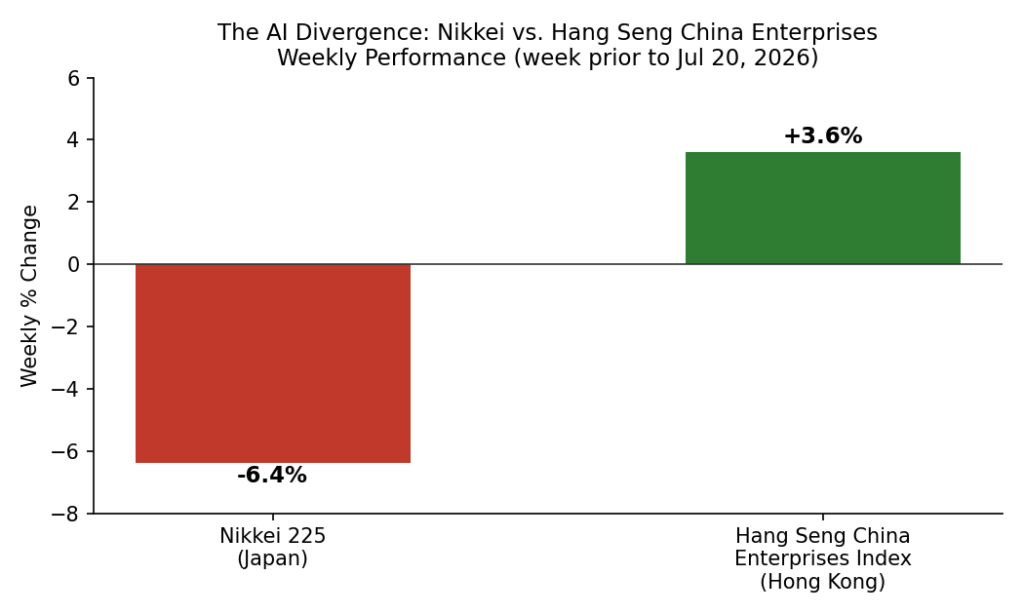
Figure: The Nikkei 225 fell 6.4% the week before July 20, while the Hang Seng China Enterprises Index rose as much as 3.6% — its best day in over a year. Same “AI theme,” opposite results.
This Week’s Asian Economic Calendar
Here are the key scheduled events for the week of July 20–24, 2026. Some China, Japan, and Australia release times can shift slightly — always check a live economic calendar closer to the date.
| Date | Country | Event | Importance | Why It Matters |
|---|---|---|---|---|
| Mon Jul 20 | China | PBOC Loan Prime Rate decision | High | A hold is expected; any surprise cut would be a strong signal for Hong Kong and China stocks. |
| Tue Jul 21 | Japan | Trade Balance data | Medium | Yen-sensitive; watch exporter stocks. |
| Wed Jul 22 | Global | Alphabet & Tesla Q2 earnings | Very High | Direct read-through to Asia’s AI/semiconductor supply chain. |
| Thu Jul 23 | China | Pre-Politburo stimulus commentary | High | Sets the tone for Hong Kong and China stocks heading into month-end. |
| Fri Jul 24 | Japan | Tokyo CPI | High | Shapes expectations ahead of the July 30–31 Bank of Japan meeting. |
| Fri Jul 24 | Japan/Korea/Taiwan | Flash manufacturing & services PMIs | Medium-High | Confirms or challenges the semiconductor demand story. |
This Week’s Asian Earnings Calendar
The two biggest earnings stories — TSMC and Samsung — already reported, but markets are still actively digesting both results this week.
| Company | Ticker | Status | Key Numbers | Surprise Risk |
|---|---|---|---|---|
| Taiwan Semiconductor | TSM / 2330.TW | Reported Jul 16; reaction continues | 2026 capex raised to $60–64B; AI/HPC = 61% of revenue | High |
| Samsung Electronics | 005930.KS | Preliminary reported Jul 7; full report Jul 30 | Operating profit ≈ 89.4T won, ~19x y/y | High |
| Renesas, Fujitsu, Hitachi, Sumitomo Mitsui, Nomura, Komatsu, Chugai Pharma, Kansai Electric | Various | In their July reporting window | Specific dates not yet confirmed for this exact week | Medium |
Top 10 Asian Stocks to Watch This Week
Ranked by how likely each stock is to make a significant move this week, based on earnings, regulatory news, and macro catalysts — not simply by company size.
| Rank | Company | Ticker | Country | Trend | Confidence |
|---|---|---|---|---|---|
| 1 | Taiwan Semiconductor | TSM | Taiwan | Bullish (long-term) | 85% |
| 2 | Samsung Electronics | 005930.KS | South Korea | Bullish (fundamentals) | 80% |
| 3 | Alibaba Group | 9988.HK | China | Bullish | 78% |
| 4 | Tencent Holdings | 0700.HK | China | Bullish | 72% |
| 5 | SoftBank Group | 9984.T | Japan | Bearish (near-term) | 65% |
| 6 | Tokyo Electron | 8035.T | Japan | Bearish (near-term) | 68% |
| 7 | Advantest | 6857.T | Japan | Bearish (near-term) | 66% |
| 8 | BYD Company | 1211.HK | China | Bullish | 70% |
| 9 | Kioxia Holdings | 285A.T | Japan | Bearish (near-term) | 60% |
| 10 | Commonwealth Bank of Australia | CBA.AX | Australia | Neutral-to-Bearish | 58% |
10 Stocks, One Volatile Week
From TSMC’s post-earnings swings to Alibaba’s AI-driven rally, this week’s top Asian stocks are moving fast. Build a watchlist and follow every tick in real time.
Set Up Your Watchlist on TradingView →1. Taiwan Semiconductor Manufacturing Company (TSM)
TSMC reported record Q2 results on July 16 and raised its 2026 capital spending guidance to $60–64 billion, driven by AI and high-performance computing demand that now makes up 61% of revenue. Yet the stock dropped nearly 7% as investors worried about rising costs squeezing margins. This week, expect continued volatility as the market keeps digesting the report — and as Alphabet and Tesla’s earnings on July 22 offer more clues about how much hyperscalers plan to keep spending on AI infrastructure.
Bullish case: Analysts remain broadly bullish (“Strong Buy” consensus), betting that AI demand keeps growing faster than costs.
Bearish case: If investors decide rising capex won’t pay off quickly enough, the stock could stay under pressure.
2. Samsung Electronics
Samsung’s preliminary Q2 profit came in about 19 times higher than a year ago — roughly 89.4 trillion won — beating expectations. Instead of celebrating, investors sold the stock nearly 7% lower, a classic “sell the news” reaction. The market is now positioning ahead of Samsung’s full divisional earnings breakdown on July 30, which should reveal how much of that profit came from memory chips versus other businesses.
Bullish case: If memory chip pricing keeps improving, the stock could quickly recover this week’s weakness.
Bearish case: If the July 30 report shows weakness in other divisions (like foundry), it could offset the memory strength.
3. Alibaba Group
Alibaba jumped as much as 11% after China approved Apple’s “Apple Intelligence” AI service — a regulatory green light that reopens the door to AI-powered features for millions of Chinese iPhone users, with Alibaba positioned to benefit. This is a concrete, confirmed catalyst, not just sentiment, and it’s part of why Hong Kong’s China tech index just had its best day in over a year.
Bullish case: Continued AI monetization and any fresh stimulus signals from China’s government could extend the rally.
Bearish case: Chinese regulators have reversed course on tech-friendly policies before, so this remains a watch item.
4. Tencent Holdings
Tencent rode the same wave of enthusiasm as Alibaba, supported by reported profit growth of 21% year-over-year as AI tools boost its advertising and gaming businesses.
Bullish case: Sustained AI-driven margin improvement could support further gains.
Bearish case: A pullback in the broader Hong Kong tech rally, or weak Chinese consumer data, could stall momentum.
5. SoftBank Group
SoftBank fell about 9% last week as part of the broader AI valuation reset in Japan, given its heavy exposure to AI-related investments (including Arm Holdings). It’s one of the most volatile large-cap ways to bet on global AI sentiment, which means it could swing sharply in either direction depending on how Alphabet and Tesla’s earnings land.
Bullish case: A stabilization in AI sentiment could spark a sharp bounce given how oversold the stock became.
Bearish case: Continued skepticism about AI spending could extend the drawdown.
6. Tokyo Electron
This semiconductor equipment maker fell over 8% last week alongside the broader Japanese tech selloff. Its fortunes are closely tied to how much chipmakers like TSMC plan to spend on new equipment — which, ironically, TSMC just said would increase.
Bullish case: If TSMC’s higher capex guidance is read as durable equipment demand, the stock could recover.
Bearish case: The stock remains exposed to any further broad de-rating of AI-related valuations.
7. Advantest
Advantest, which makes equipment used to test AI chips, dropped over 7% last week. It’s one of the highest-beta ways to trade AI infrastructure sentiment in the Japanese market — meaning it tends to move more sharply than the broader market in both directions.
Bullish case: Any positive AI capex signal from Alphabet or Tesla’s earnings could trigger a fast rebound.
Bearish case: Its rich valuation makes it vulnerable to further profit-taking.
8. BYD Company
BYD stands out as a rare steady bright spot: strong EV sales and improving battery cost curves continue to support margins even as China’s broader economy cools.
Bullish case: Continued record EV sales and export growth support further outperformance.
Bearish case: A slowdown in Chinese consumer demand could eventually weigh on domestic EV sales.
9. Kioxia Holdings
Kioxia was the single worst performer among Japan’s major tech names last week, falling over 16% on memory-chip and AI-server demand worries. It’s highly sensitive to the same memory-pricing story playing out at Samsung.
Bullish case: Confirmation of a memory-pricing upcycle (echoing Samsung’s strong results) could spark a sharp relief rally.
Bearish case: As one of the most-oversold names in the sector, it remains vulnerable to further profit-taking.
10. Commonwealth Bank of Australia
Australia’s largest bank is a useful proxy for the country’s interest-rate debate. The Reserve Bank of Australia held its cash rate at 4.35% in June after three hikes earlier in 2026, and markets are split on whether one more hike is coming later this year — a key reason the broader ASX 200 has been stuck in a tight trading range.
Bullish case: Confirmation that the RBA’s rate-hiking cycle has peaked would likely support the stock.
Bearish case: A further hike or stubborn inflation data would add pressure on bank valuations.
Country-by-Country Outlook
| Country | Weekly Outlook |
|---|---|
| Japan | Bearish-to-Neutral, high volatility. Coming off a 6.4% weekly Nikkei decline tied to the AI valuation reset. Watch Tokyo CPI (Jul 24) and positioning ahead of the July 30–31 Bank of Japan meeting. |
| China (Mainland) | Neutral, policy-dependent. Q2 GDP growth of 4.3% missed forecasts, the slowest pace since 2022. Markets are watching for stimulus signals from an expected late-July Politburo meeting. |
| Hong Kong | Bullish. The Hang Seng China Enterprises Index just had its best day in over a year, powered by the Apple Intelligence approval and a broader re-rating of Chinese internet stocks. |
| Taiwan | Bullish long-term, volatile near-term. TSMC’s earnings reaction dominates sentiment across the whole semiconductor supply chain. |
| South Korea | Bullish fundamentals, choppy price action. Samsung’s blowout preliminary profit sets a high bar ahead of its full report on July 30. |
| India | Bullish, steady. The Nifty 50 remains in a healthy uptrend, helped by lower oil prices and central bank support. |
| Australia | Neutral, range-bound. The ASX 200 is stuck between roughly 8,600 and 9,000 as markets debate whether the RBA hikes rates again. |
| Singapore | Neutral. Limited stock-specific catalysts this week; likely to track broader regional sentiment, especially from Hong Kong and China. |
Yen Volatility Building Into the BOJ Meeting
With the Bank of Japan meeting July 30–31 and Tokyo CPI due Friday, USD/JPY positioning is already shifting. Trade currency moves with tools built for active traders.
Explore Pepperstone →Sector Outlook
| Sector | Outlook | Key Catalyst |
|---|---|---|
| Artificial Intelligence | Mixed — rotating from hardware to applications | Alphabet & Tesla earnings (Jul 22) |
| Semiconductors | High volatility | TSMC and Samsung earnings digestion |
| Electric Vehicles | Bullish | Improving battery cost curves, strong exports (BYD) |
| Internet & E-commerce | Bullish | Apple Intelligence approval, AI product integration |
| Financials | Mixed, rate-sensitive | BOJ and RBA rate positioning |
| Energy | Soft | Oil oversupply concerns (~$60/bbl Brent) |
| Mining | Bullish (conditional) | AI-driven copper demand, China stimulus watch |
AI Hardware vs. AI Apps — Track the Divergence
Japan’s chip stocks are sliding while Hong Kong’s AI platforms rally. See how the sectors and indices stack up with free real-time charts and screeners.
Explore TradingView →Biggest Risks This Week
| Risk | Rating |
|---|---|
| China stimulus disappointment | High |
| Semiconductor/AI capex demand (Alphabet/Tesla earnings) | Very High |
| Global growth slowdown (China GDP read-through) | High |
| BOJ policy surprise ahead of Jul 30–31 meeting | Medium |
| RBA additional rate hike | Medium |
| Currency volatility (USD/JPY, USD/CNH) | Medium |
| Taiwan Strait tensions | Medium |
Key Takeaways
- Japan’s Nikkei fell 6.4% last week on an AI/semiconductor valuation reset — but Hong Kong’s Hang Seng China Enterprises Index just had its best day in over a year.
- China approved Apple’s “Apple Intelligence” AI service, directly boosting Alibaba (+11%) and Tencent.
- TSMC beat estimates and raised guidance on July 16 but still fell about 7% on capex and margin concerns.
- Samsung’s preliminary Q2 profit rose roughly 19-fold year-over-year, yet the stock dropped nearly 7% on profit-taking.
- China’s Q2 GDP grew 4.3%, missing forecasts and marking the slowest pace since 2022.
- Alphabet and Tesla report earnings Wednesday, July 22 — a key signal for AI-capex sentiment across Asia’s chip supply chain.
- The Bank of Japan meets July 30–31 and the Federal Reserve meets July 28–29 — both just outside this week but shaping positioning now.
- India’s Nifty 50 remains in a steady uptrend, helped by lower oil prices and RBI support.
- Australia’s ASX 200 is stuck in an 8,600–9,000 range as markets debate another RBA rate hike.
- BYD continues to post strong EV sales and improving margins, a rare steady bright spot amid China’s broader slowdown.
Frequently Asked Questions
Why did TSMC stock fall after beating earnings?
TSMC reported strong revenue growth and raised its 2026 spending guidance, but investors worried that the higher spending (capex) would squeeze profit margins in the near term. This is a common pattern: a company’s results can beat expectations while its stock still falls if the outlook raises new concerns.
Why did Samsung’s stock drop despite record profit?
Samsung’s preliminary profit jumped roughly 19-fold from a year ago, but much of that good news was already expected by investors. When results meet very high expectations exactly, some investors take profits — a pattern often called “selling the news.”
Why is Alibaba stock rising this week?
China approved Apple’s AI service, “Apple Intelligence,” for the Chinese market. This regulatory approval is expected to benefit Alibaba directly and reopened investor enthusiasm for AI monetization among Chinese internet companies.
What is the difference between AI hardware stocks and AI application stocks?
AI hardware stocks (like chipmakers and equipment suppliers) build the physical infrastructure AI runs on. AI application stocks (like cloud and internet platforms) build the software and services people actually use. This week, hardware stocks in Japan fell while application-focused stocks in Hong Kong rallied — showing these two groups don’t always move together.
What is China’s Loan Prime Rate (LPR)?
The LPR is the benchmark interest rate Chinese banks use for loans. The People’s Bank of China reviews it monthly; a hold suggests policymakers are comfortable with current conditions, while a cut would signal a push to stimulate growth.
Is the Bank of Japan raising interest rates in 2026?
The Bank of Japan’s next policy meeting is scheduled for July 30–31, 2026, just after this week. Investors are watching Japan’s inflation data (like the July 24 Tokyo CPI release) for clues on what the BOJ might do.
Related Reading
Top 10 UK Stocks to Watch This Week (July 20–24, 2026)
Top 10 US Stocks to Watch This Week (July 20–24, 2026)
The Bottom Line
This week is less about one single market direction and more about a clear split within Asia’s biggest theme: AI. Hardware and equipment names in Japan are working through a painful valuation reset, while Hong Kong’s AI-application names are enjoying a fresh regulatory tailwind. Layer in a cooling Chinese economy, blockbuster-but-underwhelming earnings reactions from TSMC and Samsung, a steady India, and a range-bound Australia, and you have a genuine stock-picker’s week rather than a one-direction market.
Keep an eye on Alphabet and Tesla’s earnings midweek — they’re likely to set the tone for Asia’s semiconductor complex through the rest of July.
Disclosure: The content on this page was produced with AI writing assistance under the editorial direction of a licensed Electrical Engineering practitioner and certified investor in different markets with over a decade of experience. All articles are reviewed and approved by the author before publication.
